Mostrando entradas con la etiqueta Fondos. Mostrar todas las entradas

sábado, 8 de febrero de 2014

La ciencia en apuros

*De Mutis a Patarroyo
*Una vida al servicio de la humanidad

Desde los días lejanos de la Expedición Botánica no ha tenido Colombia un impulsor de la cultura y la investigación de la talla y capacidad de conseguir recursos, emplearlos bien y producir resultados, como José Celestino Mutis. Cuando se revisa la historia oficial se consigna que el final del Imperio Español en América estuvo signado por el oscurantismo y el descuido de las artes y los estudios superiores. Eso se repite como un rosario por los que a la ligera repasan esos tiempos, para desacreditar y desvirtuar los grandes esfuerzos que se hicieron por la cultura en esta esquina olvidada del Imperio. El sabio Mutis, como se le conoce, desdeñó la corte madrileña y se vino a vivir a Santa Fe de Bogotá, donde emprendió notables empresas de investigación y comerciales, casi sin parangón en otras latitudes. La Expedición Botánica es un trabajo extraordinario, en el cual participaron sabios criollos que se destacaron por notable inteligencia. Ellos se habían formado en universidades locales o con preceptores nuestros. Por entonces, había más universidades en nuestra región que en las 13 colonias de Norteamérica, que ya habían librado la guerra de Independencia y establecido el sistema republicano en su país. Así que la Independencia y los acontecimientos que se sucedieron a partir de la prisión de los reyes de España, obedecen, en un principio, a factores exógenos, así se conviertan luego en guerra civil y separatista o de independencia.

Resulta interesante comparar los esfuerzos de Mutis por la cultura y la investigación, como los recursos que se invirtieron entonces y las gentes que participaron bajo su orientación en la formidable empresa, con las inversiones durante la Republica en la misma actividad. La ciencia ha estado expósita en el país, abandonada por el Estado en no pocos casos, ignorada por los legisladores y por los políticos, que no siempre entienden su importancia. Lo que de alguna manera tiende a cambiar en los últimos tiempos. Mientras en los Estados Unidos, la Universidad está ligada desde sus inicios a la investigación, las necesidades del Gobierno y la sociedad, en tanto cuenta con la comunicación permanente con el sector privado, en el país hasta ahora se hacen esfuerzos en ese sentido.

Y cuando se destinan fondos apreciables del Estado para investigación no siempre se emplean como es debido, se utiliza buena parte en burocracia y en gastos que desvirtúan la finalidad que se busca. Lo peor es que en ocasiones se persigue a los investigadores. El caso de Elkin Patarroyo, uno de los investigadores más notables y capaces, es elocuente. Se trata de un científico que dedica su vida a intentar curar por medio de vacunas químicas enfermedades que atacan al ser humano, le deparan terribles sufrimientos y a los que peor les va los manda a la tumba. El científico lleva décadas de su existencia con muchísimas noches en vela dedicadas a encontrar cómo salvar a millones de seres, en su mayoría los más pobres que padecen horribles males y languidecen en pésimas condiciones de vida. Para sus estudios necesita experimentar con micos, que tienen cierto parecido constitucional con los humanos. Sin esas investigaciones es imposible avanzar en sus ambiciosos proyectos de derrotar varias de las enfermedades endémicas que azotan a la humanidad. Pues resulta que no faltan los que lo acusan de abominar y perseguir a los animales, que desean que sus proyectos científicos fracasen y evitar triunfe sobre la enfermedad y beneficie a millones de seres. La envidia y la incomprensión buscan desacreditarlo y desean frustrar sus investigaciones. Por fortuna el carácter indomable del científico no se deja arredrar y sigue su trabajo humanitario con fervor y humildad.

Se le reconoce a Patarroyo como uno de los pioneros colombianos en el medio científico desde 1987 por los experimentos en humanos de zonas endémicas de un protocolo de vacuna sintética y los importantes avances subsiguientes, para combatir la malaria, una enfermedad mutante. Resulta increíble que gentes que no entienden los avances de la ciencia y los alcances de la investigación que orienta el científico colombiano, como el significado portentoso para la humanidad de culminar su trabajo, no vacilan en intentar paralizar su actividad. Es doloroso constatar que un elemento tan valioso deba gastar más tiempo defendiendo su actividad científica y en la consecución de recursos que en la investigación. Es incomprensible que el Estado colombiano no le apoye más y le evite ese desgaste de energías


ORIGINAL: Nuevo Siglo
Febrero 7, 2014

domingo, 21 de julio de 2013

Why We Can´t Solve Big Problems?

October 24, 2012


On July 21, 1969, Buzz Aldrin climbed gingerly out of Eagle, Apollo 11’s lunar module, and joined Neil Armstrong on the Sea of Tranquility. Looking up, he said, “Beautiful, beautiful, magnificent desolation.” They were alone; but their presence on the moon’s silent, gray surface was the culmination of a convulsive collective effort.

Eight years before, President John F. Kennedy had asked the United States Congress to “commit itself to achieving the goal, before this decade is out, of landing a man on the moon and returning him safely to the Earth.” His challenge disturbed the National Aeronautics and Space Administration’s original plan for a stepped, multi-generational strategy: Wernher von Braun, NASA’s chief of rocketry, had thought the agency would first send men into Earth’s orbit, then build a space station, then fly to the moon, then build a lunar colony. A century hence, perhaps, humans would travel to Mars. Kennedy’s goal was also absurdly ambitious. A few weeks before his speech, NASA had strapped an astronaut into a tiny capsule atop a converted military rocket and shot him into space on a ballistic trajectory, as if he were a circus clown; but no American had orbited the planet. The agency didn’t really know if what the president asked could be done in the time he allowed, but it accepted the call.

This required the greatest peacetime mobilization in the nation’s history. Although NASA was and remains a civilian agency, the Apollo program was possible only because it was a lavishly funded, semi-militarized project: all the astronauts (with one exception) had been Air Force pilots and naval aviators; many of the agency’s middle-aged administrators had served in the Second World War in some capacity; and the director of the program itself, Samuel Philips, was an Air Force general officer, drafted into service because of his effective management of the Minuteman missile program. In all, NASA spent $24 billion, or about $180 billion in today’s dollars, on Apollo; at its peak in the mid-1960s, the agency enjoyed more than 4 percent of the federal budget. The program employed around 400,000 people and demanded the collaboration of about 20,000 companies, universities, and government agencies.

If Apollo commanded a significant portion of the treasure of the world’s richest nation and the cooperation of all its estates, that was because Kennedy’s challenge required NASA to solve a bewildering number of smaller problems decades ahead of technology’s evolutionary schedule. The agency’s solutions were often inelegant. To escape from orbit, NASA constructed 13 giant, single–use multistage rockets, capable of lifting 50 tons of payload and generating 7.6 million pounds of thrust. Only an ungainly modular spacecraft could be flown by the deadline; but docking the command and lunar modules midflight, sending the lunar module to the moon’s surface, and then reuniting the modules in lunar orbit demanded a kind of spastic space dance and forced the agency’s engineers to develop and test a long series of astronautical innovations. Men died, including the crew of Apollo 1, who burned in the cabin of their command module. But before the program ended in 1972, 24 men flew to the moon. Twelve walked on its surface, of whom Aldrin, following the death of Armstrong last August, is now the most senior.

Why did they go? They brought back little—841 pounds of old rocks, Aldrin’s smuggled aesthetic bliss, and something most of the 24 emphasized: a new sense of the smallness and fragility of our home. (Jim Lovell, not untypically, remembered, “Everything that I ever knew—my life, my loved ones, the Navy—everything, the whole world, was behind my thumb.”) The cynical, mostly correct answer is that Kennedy wanted to demonstrate the superiority of American rocketry over Soviet engineering: the president’s challenge was made in May of 1961, little more than a month after Yuri Gagarin became the first human in space. But it does not adequately explain why the United States made the great effort it did, nor does it convey how the lunar landings were understood at the time.

Kennedy’s words, spoken at Rice University in 1962, provide a better clue:

But why, some say, the moon? Why choose this as our goal? .?.?. Why climb the highest mountain? Why, 35 years ago, fly the Atlantic? .?.?. We choose to go to the moon in this decade and do the other things, not because they are easy, but because they are hard; because that goal will serve to organize and measure the best of our energies and skills .?.?.

Apollo was not seen only as a victory for one of two antagonistic ideologies. Rather, the strongest emotion at the time of the moon landings was of wonder at the transcendent power of technology. From his perch in Lausanne, Switzerland, the writer Vladimir Nabokov cabled the New York Times, “Treading the soil of the moon, palpating its pebbles, tasting the panic and splendor of the event, feeling in the pit of one’s stomach the separation from terra—these form the most romantic sensation an explorer has ever known.

To contemporaries, the Apollo program occurred in the context of a long series of technological triumphs. The first half of the century produced the assembly line and the airplane, penicillin and a vaccine for tuberculosis; in the middle years of the century, polio was on its way to being eradicated; and by 1979 smallpox would be eliminated. More, the progress seemed to possess what Alvin Toffler dubbed an “accelerative thrust” in Future Shock, published in 1970. The adjectival swagger is pardonable: for decades, technology had been increasing the maximum speed of human travel. During most of history, we could go no faster than a horse or a boat with a sail; by the First World War, automobiles and trains could propel us at more than 100 miles an hour. Every decade thereafter, cars and planes sped humans faster. By 1961, a rocket-powered X-15 had been piloted to more than 4,000 miles per hour; in 1969, the crew of Apollo 10 flew at 25,000. Wasn’t it the very time to explore the galaxy—”to blow this great blue, white, green planet or to be blown from it,” as Saul Bellow wrote in Mr. Sammler’s Planet (also 1970)?
Perhaps the most influential photograph from the Apollo lunar landings: Buzz Aldrin’s footprint in the moon’s gray, powdery surface.

Since Apollo 17’s flight in 1972, no humans have been back to the moon, or gone anywhere beyond low Earth orbit. No one has traveled faster than the crew of Apollo 10. (Since the last flight of the supersonic Concorde in 2003, civilian travel has become slower.) Blithe optimism about technology’s powers has evaporated, too, as big problems that people had imagined technology would solve, such as hunger, poverty, malaria, climate change, cancer, and the diseases of old age, have come to seem intractably hard.

I remember sitting in my family’s living room in Berkeley, California, watching the liftoff of Apollo 17. I was five; my mother admonished me not to stare at the fiery exhaust of the Saturn 5 rocket. I vaguely knew that this was the last of the moon missions—but I was absolutely certain that there would be Mars colonies in my lifetime. What happened?

Parochial Explanations

That something happened to humanity’s capacity to solve big problems is a commonplace. Recently, however, the complaint has developed a new stridency among Silicon Valley’s investors and entrepreneurs, although it is usually expressed a little differently: people say there is a paucity of real innovations. Instead, they worry, technologists have diverted us and enriched themselves with trivial toys.

The motto of Founders Fund, a venture capital firm started by Peter Thiel, a cofounder of PayPal, is “We wanted flying cars—instead we got 140 characters.” Founders Fund matters, because it is the investment arm of what is known locally as the “PayPal Mafia,” currently the dominant faction in Silicon Valley, which remains the most important area on the planet for technological innovation. (Other members include Elon Musk, the founder of SpaceX and Tesla Motors; Reid Hoffman, executive chairman of LinkedIn; and Keith Rabois, chief operating officer of the mobile payments company Square.) Thiel is caustic: last year he told the New Yorker that he didn’t consider the iPhone a technological breakthrough. “Compare [it] with the Apollo program,” he said.The Internet is “a net plus—but not a big one.” Twitter gives 500 people “job security for the next decade,” but “what value does it create for the entire economy?” And so on. Max Levchin, another cofounder of PayPal, says, “I feel like we should be aiming higher. The founders of a number of startups I encounter have no real intent of getting anywhere huge … There’s an awful lot of effort being expended that is just never going to result in meaningful, disruptive innovation.


But Silicon Valley’s explanation of why there are no disruptive innovations is parochial and reductive: the markets—in particular, the incentives that venture capital provides entrepreneurs—are to blame. According to Founders Fund’s manifesto, “What Happened to the Future?,” written by Bruce Gibney, a partner at the firm: “In the late 1990s, venture portfolios began to reflect a different sort of future … Venture investing shifted away from funding transformational companies and toward companies that solved incremental problems or even fake problems … VC has ceased to be the funder of the future, and instead become a funder of features, widgets, irrelevances.” Computers and communications technologies advanced because they were well and properly funded, Gibney argues. But what seemed futuristic at the time of Apollo 11 “remains futuristic, in part because these technologies never received the sustained funding lavished on the electronics industries.

The argument, of course, is wildly hypocritical. PayPal’s capos made their fortunes in public stock offerings and acquisitions of companies that did more or less trivial things. Levchin’s last startup, Slide, was a Founders Fund investment: it was acquired by Google in 2010 for about $200 million and shuttered earlier this year. It developed Facebook widgets such as SuperPoke and FunWall.

But the real difficulty with Silicon Valley’s explanation is that it is insufficient to the case. The argument that venture capitalists lost their appetite for risky but potentially important technologies clarifies what’s wrong with venture capital and tells us why half of all funds have provided flat or negative returns for the last decade. It also usefully explains how a collapse in nerve reduced the scope of the companies that got funded: with the exception of Google (which wants to “organize the world’s information and make it universally accessible and useful”), the ambitions of startups founded in the last 15 years do seem derisory compared with those of companies like Intel, Apple, and Microsoft, founded from the 1960s to the late 1970s. (Bill Gates, Microsoft’s founder, promised to “put a computer in every home and on every desktop,” and Apple’s Steve Jobs said he wanted to make the “best computers in the world.”) But the Valley’s explanation conflates all of technology with the technologies that venture capitalists like: traditionally, as Gibney concedes, digital technologies. Even during the years when VCs were most risk-happy, they preferred investments that required little capital and offered an exit within eight to 10 years. The venture capital business has always struggled to invest profitably in technologies, such as biotechnology and energy, whose capital requirements are large and whose development is uncertain and lengthy; and VCs have never funded the development of technologies that are meant to solve big problems and possess no obvious, immediate economic value. The account is a partial explanation that forces us to ask: putting aside the personal-computer revolution, if we once did big things but do so no longer, then what changed?

Silicon Valley’s explanation has this fault, too: it doesn’t tell us what should be done to encourage technologists to solve big problems, beyond asking venture capitalists to make better investments. (Founders Fund promises to “run the experiment” and “invest in smart people solving difficult problems, often difficult scientific or engineering problems.”) Levchin, Thiel, and Garry Kasparov, the former world chess champion, had planned a book, to be titled The Blueprint, that would “explain where the world’s innovation has gone.” Originally intended to be released in March of this year, it has been indefinitely postponed, according to Levchin, because the authors could not agree on a set of prescriptions.

Let’s stipulate that venture-backed entrepreneurialism is essential to the development and commercialization of technological innovations. But it is not sufficient by itself to solve big problems, nor could its relative sickliness by itself undo our capacity for collective action through technology.

Irreducible Complexities

The answer is that these things are complex, and that there is no one simple explanation.

Sometimes we choose not to solve big technological problems. We could travel to Mars if we wished. NASA has the outline of a plan—or, in its bureaucratic jargon, a “design reference architecture.” To a surprising degree, the agency knows how it might send humans to Mars and bring them home. “We know what the challenges are,” says Bret Drake, the deputy chief architect for NASA’s human spaceflight architecture team. “We know what technologies, what systems we need” (see “The Deferred Dreams of Mars”). As Drake explains, the mission would last about two years; the astronauts would spend 12 months in transit and 500 days on the surface, studying the geology of the planet and trying to understand whether it ever harbored life. Needless to say, there’s much that NASA doesn’t know: whether it could adequately protect the crew from cosmic rays, or how to land them safely, feed them, and house them. But if the agency received more money or reallocated its current spending and began working to solve those problems now, humans could walk on the Red Planet sometime in the 2030s.

We won’t, because there are, everyone feels, more useful things to do on Earth. Going to Mars, like going to the moon, would follow upon a political decision that inspired or was inspired by public support. But almost no one feels Buzz Aldrin’s “imperative to explore” (see the astronaut’s sidebar).

Sometimes we fail to solve big problems because our institutions have failed. In 2010, less than 2 percent of the world’s energy consumption was derived from advanced renewable sources such as wind, solar, and biofuels. (The most common renewable sources of energy are still hydroelectric power and the burning of biomass, which means wood and cow dung.) The reason is economic: coal and natural gas are cheaper than solar and wind, and petroleum is cheaper than biofuels. Because climate change is a real and urgent problem, and because the main cause of global warming is carbon dioxide released as a by-product of burning fossil fuels, we need renewable energy technologies that can compete on price with coal, natural gas, and petroleum. At the moment, they don’t exist.

Happily, economists, technologists, and business leaders agree on what national policies and international treaties would spur the development and broad use of such alternatives. There should be a significant increase in public investment for energy research and development, which has fallen in the United States from a height of 10 percent in 1979 to 2 percent of total R&D spending, or just $5 billion a year. (Two years ago, Bill Gates, Xerox chief executive Ursula Burns, GE chief executive Jeff Immelt, and John Doerr, the Silicon Valley venture capitalist, called for a threefold increase in public investments in energy research.) There should be some kind of price on carbon, now a negative externality, whether it is a transparent tax or some more opaque market mechanism. There should be a regulatory framework that treats carbon dioxide emissions as pollution, setting upper limits on how much pollution companies and nations can release. Finally, and least concretely, energy experts agree that even if there were more investment in research, a price on carbon, and some kind of regulatory framework, we would still lack one vital thing: sufficient facilities to demonstrate and test new energy technologies. Such facilities are typically too expensive for private companies to build. But without a practical way to collectively test and optimize innovative energy technologies, and without some means to share the risks of development, alternative energy sources will continue to have little impact on energy use, given that any new technology will be more expensive at first than fossil fuels.

Less happily, there is no hope of any U.S. energy policy or international treaties that reflect this intellectual consensus, because one political party in the United States is reflexively opposed to industrial regulations and affects to doubt that human beings are causing climate change, and because the emerging markets of China and India will not reduce their emissions without offset benefits that the industrialized nations cannot provide. Without international treaties or U.S. policy, there will probably be no competitive alternative sources of energy in the near future, barring what is sometimes called an “energy miracle.

Sometimes big problems that had seemed technological turn out not to be so, or could more plausibly be solved through other means. Until recently, famines were understood to be caused by failures in food supply (and therefore seemed addressable by increasing the size and reliability of the supply, potentially through new agricultural or industrial technologies). But Amartya Sen, a Nobel laureate economist, has shown that famines are political crises that catastrophically affect food distribution. (Sen was influenced by his own experiences. As a child he witnessed the Bengali famine of 1943: three million displaced farmers and poor urban dwellers died unnecessarily when wartime hoarding, price gouging, and the colonial government’s price–controlled acquisitions for the British army made food too expensive. Sen demonstrated that food production was actually higher in the famine years.) Technology can improve crop yields or systems for storing and transporting food; better responses by nations and nongovernmental organizations to emerging famines have reduced their number and severity. But famines will still occur because there will always be bad governments.

Yet the hope that an entrenched problem with social costs should have a technological solution is very seductive—so much so that disappointment with technology is inevitable. Malaria, which the World Health Organization estimates affected 216 million people in 2010, mostly in the poor world, has resisted technological solutions: infectious mosquitoes are everywhere in the tropics, treatments are expensive, and the poor are a terrible market for drugs. The most efficient solutions to the problem of malaria turn out to be simple: eliminating standing water, draining swamps, providing mosquito nets, and, most of all, increasing prosperity. Combined, they have reduced malarial infections. But that hasn’t stopped technologists such as Bill Gates and Nathan Myhrvold, the former chief technology officer of Microsoft (who writes about the role of private investors in spurring innovation), from funding research into recombinant vaccines, genetically modified mosquitoes, and even mosquito-zapping lasers. Such ideas can be ingenious, but they all suffer from the vanity of trying to impose a technological solution on what is a problem of poverty.

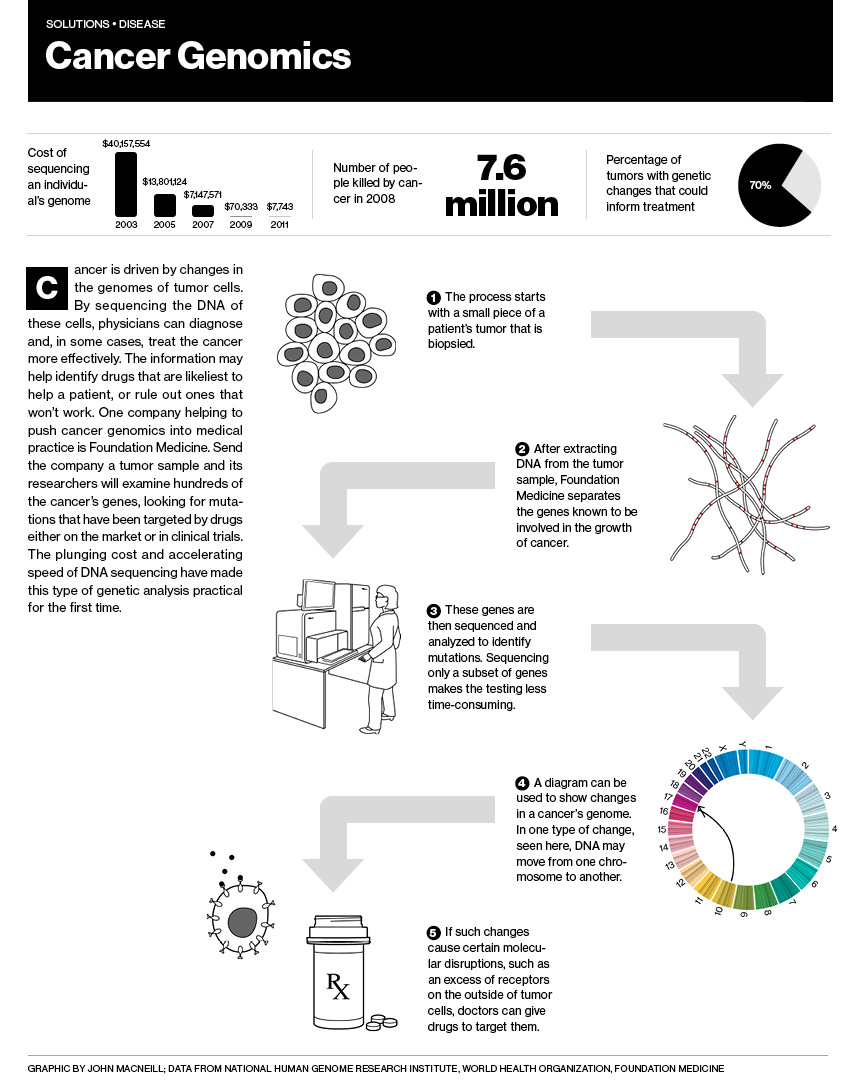
Finally, sometimes big problems elude any solution because we don’t really understand the problem. The first successes of biotechnology in the late 1970s were straightforward: breakthroughs in manufacturing, in which recombinant E. coli bacteria were coaxed into producing synthetic versions of insulin or human growth hormone, proteins whose functions we thoroughly understood. Further breakthroughs in biomedicine have been more difficult to achieve, however, because we have struggled to understand the fundamental biology of many diseases. President Richard Nixon declared war on cancer in 1971; but we soon discovered there were many kinds of cancer, most of them fiendishly resistant to treatment, and it is only in the last decade, as we have begun to sequence the genomes of different cancers and to understand how their mutations express themselves in different patients, that effective, targeted therapies have come to seem viable. (To learn more, see “Cancer Genomics.”) Or consider the “dementia plague,” as Stephen S. Hall has. As the populations of the industrialized nations age, it is emerging as the world’s most pressing health problem: by 2050, palliative care in the United States alone will cost $1 trillion a year. Yet we understand almost nothing about dementia and have no effective treatments. Hard problems are hard.

What to Do

It’s not true that we can’t solve big problems through technology; we can. We must. But all these elements must be present: political leaders and the public must care to solve a problem, our institutions must support its solution, it must really be a technological problem, and we must understand it.

The Apollo program, which has become a metaphor for technology’s capacity to solve big problems, met these criteria, but it is an irreproducible model for the future. This is not 1961: there is no galvanizing historical context akin to the Cold War, no likely politician who can heroize the difficult and dangerous, no body of engineers who yearn for the productive regimentation they had enjoyed in the military, and no popular faith in a science-fictional mythology such as exploring the solar system. Most of all, going to the moon was easy. It was only three days away. Arguably, it wasn’t even solving much of a problem. We are left alone with our day, and the solutions of the future will be harder won.

We don’t lack for challenges.  
  • A billion people want electricity,  
  • millions are without clean water, 
  • the climate is changing, 
  • manufacturing is inefficient, 
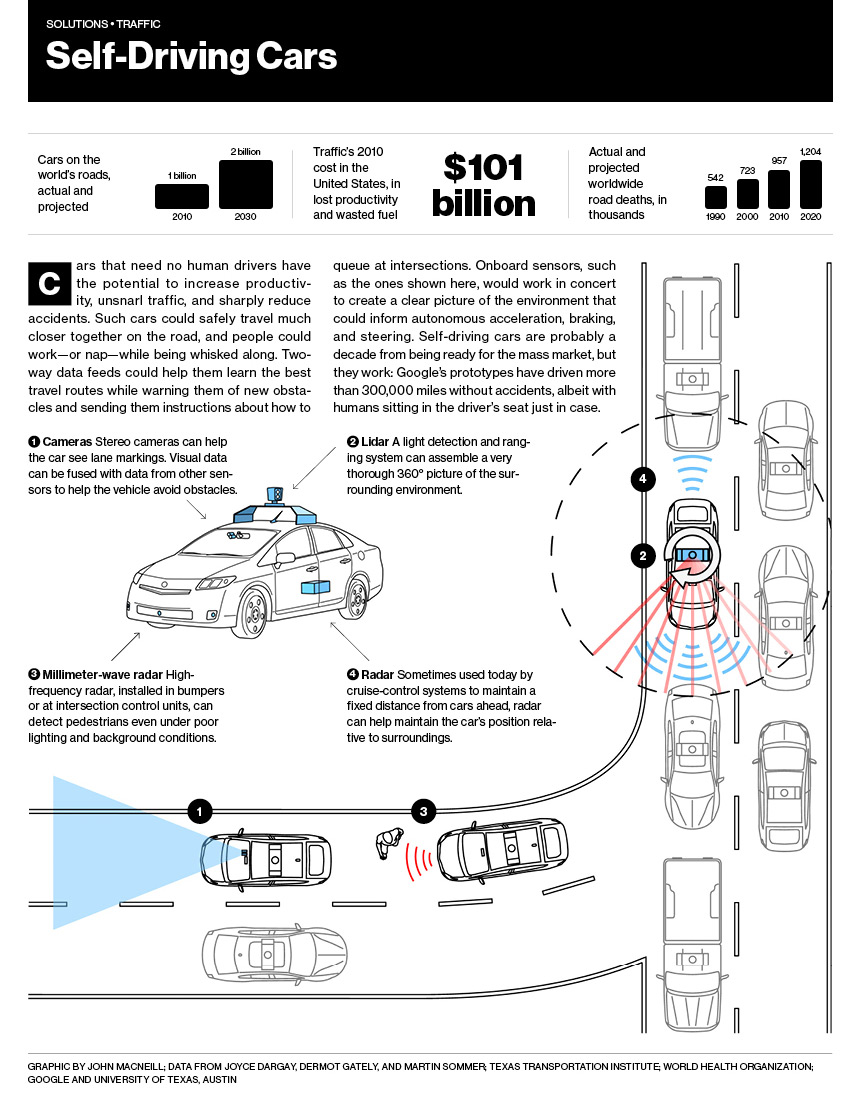
  • traffic snarls cities, 
  • education is a luxury, and 
  • dementia or cancer will strike almost all of us if we live long enough. 
In this special package of stories, we examine these problems and introduce you to the indefatigable technologists who refuse to give up trying to solve them.


sábado, 30 de marzo de 2013

Is Brain Mapping Ready for Big Science?

ORIGINAL: GEN


The BAM project will be an expensive undertaking. Will it be worth the cost?

The Brain Activity Map Project is aimed at reconstructing the full record of neural activity across complete neural circuits, with the goal of understanding fundamental and pathological brain processes. [V. Yakobchuk/Fotolia.com]
President Barack Obama’s public-private initiative to create an activity map of the human brain will cost more than $3 billion, projections say, or $300 million annually for 10 years. The project has multiple private and public institutions lined up to participate, including the Defense Advanced Research Projects Agency (DARPA) and the National Science Foundation. All parties hope that the initiative will move brain science forward with the same kind of money and focused effort that drove the Genome Project.

Every dollar we invested to map the human genome returned $140 to our economy—every dollar,” the president commented. “Today our scientists are mapping the human brain to unlock the answers to Alzheimer’s. They’re developing drugs to regenerate damaged organs, devising new materials to make batteries 10 times more powerful. Now is not the time to gut these job-creating investments in science and innovation.

George M. Church, Ph.D., professor of genetics at Harvard Medical School and director of PersonalGenomes.org, said he was helping to plan the Brain Activity Map project.

If you look at the total spending in neuroscience and nanoscience that might be relative to this today, we are already spending more than that. We probably won’t spend less money, but we will probably get a lot more bang for the buck,” he commented in the New York Times.

BAM
The proposal for the project came from six scientists, among them Dr. Church, who said in the journal Neuron, “We propose launching a large-scale, international public effort, the Brain Activity Map project (BAM), aimed at reconstructing the full record of neural activity across complete neural circuits. This technological challenge could prove to be an invaluable step toward understanding fundamental and pathological brain processes.

The collective idea for the initiative was generated at a meeting of neuroscientists and nanoscientists convened in September 2011 at the Kavli Royal Society International, U.K., organized by Tom Kalil, deputy director for policy at the White House’s Office of Science and Technology Policy (OSTP), and Miyoung Chun, Ph.D., vice president of science programs at the Kavli Foundation in Oxnard, California.

The Kavli institute has founded institutes for brain science at UC San Diego, Yale, and the Norwegian University of Science and Technology.

Meeting attendees articulated the issues the BAM will address in its report, mentioning “our persistent ignorance of the brain’s micro-circuitry—the minute and multitudinous connections contained within,” and citing the great brain scientist Ramon y Cajal’s 1923 quote that refers to the interconnected, intermixed, and dynamical network of different cell types as “impenetrable jungles where many investigators have lost themselves.” “Another equally fundamental shortcoming,” they noted, “is our inability to monitor network interactions and coordinated brain activities densely, and to do so simultaneously across extended regions of the brain, and with sufficient temporal and spatial resolution.

And most scientists, whether proponents or opponents of the big science approach to brain mapping, agree that its biggest challenge is the need to develop novel tools to study the brain.

Revolutionary New Tools Needed
Partha Mitra, Ph.D., a theoretical physicist and currently Crick-Clay professor of biomathematics at Cold Spring Harbor Laboratory, says that current methods to visualize living or dead brains provide only glimpses of small portions of the full spatial extent of neurons in the human brain, or pictures of thin sections of brain, with pieces of the neurons in them. “No one has yet seen, under the microscope or in digital reconstruction, a complete human brain neuron that sends projections to distant parts of the brain. To do that at the whole-brain scale would be like seeing a new continent or planet.Dr. Mitra’s research currently combines experimental, theoretical, and informatics approaches to gain an understanding of how brains work.

Dr. Chun has been developing the project since the beginning and has described herself as the “glue” holding the diverse stakeholders together. She told Nature that “there’s clearly an issue with tool development—and not just amending current, existing tools, although that will be important in the initial stages. In the long run, one of the very important points would be to come up with revolutionary new tools that will measure brain activity in a completely different way than what we know now.

And project proponents say the only way to tackle some thus far tricky intractable human diseases, like Alzheimer’s and Parkinson’s disease, is with a huge program. “We are right on the edge of finding out really vital information about the brain,” says Brown University neuroscientist John Donoghue, Ph.D., who was part of the project team. “There are questions we can now answer that can only be tackled as a collaborative project,” not by individual labs.

In Dr. Donaghue's view, the problem is that the people developing novel technologies and the neuroscience community don’t communicate effectively. Biologists don't know enough about the tools already out there, and the materials scientists aren't getting feedback from them on ways to make their tools more useful.

Economic Incentives
And there’s no denying the economic incentives the project provides. “What motivates people to pursue these big projects is not the belief that they will solve problems,” says Michael Eisen, Ph.D., a biologist at the University of California, Berkeley. “It’s the belief that this is the way to get money.”

John Mazziotta, M.D., Ph.D., UCLA’s department of neurology chair and director of its Brain Mapping Center, says, “This initiative is more comprehensive than anything I’ve ever seen medicine and neuroscience. This effort will be both the stimulus and the challenge to work and collaborate in ways we haven’t done before, but always have wanted to.

UCLA will likely benefit handsomely from the initiative as it says it is “well-positioned” to play a significant role in the effort and to capture funding that will support such an initiative, owing to the existence Ahmanson-Lovelace Brain Mapping Center and its “excellence” in nanoscience and nanotechnology.

Dr. Church is also in favor of spreading the funding for the project around. In an interview with Harvard Medical School News last month, he said, “The Genome Project didn’t adequately embrace small science. I think enabling small labs to do amazing things might be more powerful than having a juggernaut of a large lab, or worse yet, a race among a few large labs.

A report from the Battelle Technology Partnership says that, between 1988 and 2010, federal investment in genomic research generated an economic impact of $796 billion, “impressive” considering that Human Genome Project (HGP) spending between 1990–2003 amounted to $3.8 billion and an ROI of 141:1.

Apart from job creation and ROI, if this massive initiative provides new treatment targets for intractable human neurological and psychiatric disorders, it will have been worth the investment.

Patricia Fitzpatrick Dimond, Ph.D. (pdimond@genengnews.com), is technical editor at Genetic Engineering & Biotechnology News.

lunes, 19 de noviembre de 2012

Science for Hire: Why Industry's Deep Pockets May Be Depleting the Last of Our Fisheries

ORIGINAL: AlterNet
November 17, 2012 | 

To understand how this happens one must dig into the details of fisheries science -– a science that holds profound ramifications for the future of fish in our oceans.

Photo Credit: AFP
This story first appeared on Public Trust Project.

It’s sunset in Woods Hole, Massachusetts, a time when the little town’s handful of shops board up for the night, and the lights click off at no fewer than six marine research institutes.

But at the far end of the town, one block from the churning Atlantic, 10 weary scientists sit around a big square table arguing about cod. They’ve been at it since 8 a.m.. Each has blocked two weeks in his or her calendar for this single purpose. 

The group is meeting at the Woods Hole Aquarium, the oldest saltwater aquarium in the country, which also houses office space for 45 federal scientists working for the National Oceanic and Atmospheric Administration (NOAA). There are no cod fish to be seen in the aquarium’s tanks. There aren’t many cod in the ocean either, compared to historic levels, and it is on this point that the scientists are squabbling.

It’s not that they all disagree. In fact, there is consensus on most points among nine NOAA scientists who are attending the meeting. Their job it is to analyze fish populations in New England waters for the federal government – among them cod, pollock, and flounder.

But one prominent dissenter withholds his consensus vote: Doug Butterworth, the lone representative of the fishing industry at the session.

Butterworth is a renowned scientist based at the University of Cape Town in South Africa. He’s been lauded for his extensive contributions to the science of fishery management in many different countries. But he also has a controversial side job: he’s employed by commercial fishermen in the Gulf of Maine, who fly him into town every now and again to wage scientific war on the NOAA biologists.

It’s a role that has gained him some notoriety. “Doug seems like he’s got a retainer up here,” said Dr. Liz Brooks, a NOAA fisheries biologist who has worked on measuring pollock and cod populations.

Cod is an iconic species. Fishermen began harvesting them in the 17th century, when the fish were so abundant in New England it was said that you could walk across the sea on their backs. Over the centuries, cod’s abundance made it what Paul Greenberg called a “workaday fish,” in his lovely book Four Fish. Cod became a common, plentiful source of protein for the working class

By the 20th century, innovations in fishing technology led to the rise of giant, industrial factory ships, which began to displace small-scale cod fleets, and a new era of overfishing was born. In the mid 1990s, scientists feared the cod population would collapse altogether due to extreme fishing pressure.

Finally, the government made the tough call to close Georges Bank to commercial cod fishing in 1994. The waters – an elevated shelf of sea floor in the Gulf of Maine – were once among the most productive fishing grounds in the nation. Since then, portions of Georges Bank and the Gulf of Maine have reopened to cod fishermen, but fishing pressure is just one-third of what it was 15 years ago. Even so, fishermen have been engaged in an elaborate dance with NOAA to prove that there are plenty of fish in the sea for the taking. Doug Butterworth has been a key part of their strategy.

Butterworth’s tactic is always the same: to challenge the notion that fish populations are as small as the government says they are, helping to ward off regulations that reduce the amount of fish that industry is permitted to take from the sea. To understand how he operates, one must dig into the complex details of fisheries science – a science that holds profound ramifications for the future of fish in our oceans.

Just over a year ago, in October 2011, this same group of NOAA researchers made a startling discovery. A newly completed computer model (called a “stock assessment”) indicated that the cod population in the Gulf of Maine had fallen so dramatically that even a complete moratorium on cod fishing would not allow the population to rebuild by 2014 -- the cutoff date mandated by federal law.

That year, commercial cod fishermen had hauled in approximately 8 million pounds of cod from the muddy bottom of the Gulf of Maine. Those working fishermen feared that the finding that cod stocks were perilously low would all but put them out of business by triggering regulations severely curtailing the amount of fishing allowed.

The scientists were surprised by what they found. A previous stock assessment, completed in 2008, had identified a cod population on the upswing – in fact, cod had been held up as an example of a fishery well on the way to recovery after near collapse. But between 2008 and 2011, 48 million pounds of fish had seemingly vanished.

To make sure the computer model wasn’t erring, Michael Palmer, the head NOAA scientist for the 2011 stock assessment, spent six months running the numbers. “It was by far the best stock assessment I’ve ever seen,” said Jud Crawford, science and policy manager at the Pew Environment Group. “Mike Palmer did every conceivable analysis.”

Palmer realized that a few lucky trawls by government boats surveying the Gulf of Maine in the early 2000s had given NOAA a misleading impression of the health of the cod population. The trawl nets had mysteriously filled with juvenile fish who were expected to build into a healthy, bountiful “year class” of adults. But they never did.

The New England groundfishing industry – the group of companies that harvest fish inhabiting the deep, chilly Gulf of Maine waters that stretch from Cape Cod to Nova Scotia, were not pleased with the findings. 

I’m telling you, it’s out there,” cod fishermen Russell Sherman told the New York Times. “We’ve had no problems locating codfish.

We don’t trust your data,” New Hampshire charter boat fishermen Bill Wagner explained to regulators at a meeting that was reported on by the Associated Press.

Facing the possibility of potential restrictions to their harvest, industry representatives took action. Butterworth appeared at the cod meetings bearing an alternate computer model -- one that projected nearly 40 percent more cod in Gulf of Maine waters than the model run by the NOAA scientists. His participation was commissioned by the Northeast Seafood Coalition and the Associated Fisheries of Maine.

Butterworth used a statistical strategy called dome shaped selectivity” -- fisheries jargon for a model that assumes that the largest, most fecund animals escape capture by commercial fishermen, and therefore are not factored into the models run by government scientists. This in turn raises estimates of the number of fish in the ocean – a very good thing if you are a commercial fisherman trying to avoid regulations. 

With dome shaped selectivity, you are assuming that there are older fish out there, so the model creates them. But if you’re wrong, you are saying the stock is in much better shape than in fact it is,” said Dick Brame of the Coastal Conservation Association. “Dome shaped selectivity is the du jour way to influence stock assessments.

Because Butterworth’s 2011 cod model found more cod fish than NOAA’s model, the scientists had to come to a consensus. Industry participation in the scientific process is permitted under the Magnuson Stevens Act, which enables cooperative research among scientists, fishery managers, educational institutions, and stakeholders.

Building a consensus among participants is not mandated by the law, but it adds to the credibility of the scientists’ report. Dr. Paul Rago, a NOAA fishery biologist who supervises the New England groundfish assessments, says that it’s “something that you desire to have as a way of providing scientific advice to the [fishery] managers.

Consensus wasn’t easy to come by.

NOAA scientists spent a week forming a fragile scientific agreement with Butterworth. Collectively, they decided to use the government’s model, but they would employ some of Butterworth’s dome-shaped selectivity – effectively agreeing to generate more cod. Initially, Butterworth agreed to the compromise, and a report was drafted with preliminary recommendations to the New England Fishery Management Council, the body that regulates cod and other species in the Gulf of Maine.

Shortly after, Butterworth reneged on the consensus agreement. He distributed a paper to New England fishery managers that made a case for greater dome selectivity, among other modifications to the model.

Normally, when a stock assessment is completed, it goes through a rigorous peer review process. A selective group of independent scientists from around the world spend a week in Woods Hole at NOAA’s Northeast Fishery Science Center, learning about the computer model and evaluating whether it accurately models the number of fish in the sea. Only when the peer reviewers sign off on the assessment do fishery managers set regulations, such as limiting the amount of fishing. It’s not taken lightly since those kinds of decrees can affect the livelihoods of fishermen. 

This time, the rules of engagement were ignored. Fishing industry allies pounced before the peer reviewers had reached a verdict on the cod assessment. Sen. John Kerry of Massachusetts issued a press release calling on NOAA to “immediately conduct a new assessment” with “complete information that has been developed with the consent of all stakeholders.

Days later, the peer reviewers completed their final report – and NOAA’s assessment stood as the best available science: “The panel unanimously recommends that the results of the Gulf of Maine cod stock assessment be used for management of this stock,” they wrote

But it didn’t matter – enough doubt had been raised over the validity of the science. Nineteen New England lawmakers, including seven U.S. House members and five Senators addressed the Secretary of Commerce, asking that NOAA prioritize further research that considers “the analysis provided by Drs. Butterworth and [Rebecca] Rademeyer.” (Rademeyer is Butterworth’s associate)

Ultimately, the lawmakers got their wish. NOAA leadership instructed its biologists to redo the stock assessment in 2012 – two years earlier than scheduled, at a considerable price to the American taxpayer. Stock assessments cost upwards of $200,000, according to Dr. Rago. 

In the meantime, the New England Fishery Management Council decided to cut the harvest of cod by just 20 percent, from 17 million pounds to 14 million pounds. NOAA had recommended a 70 percent decrease in catch in order to preserve Gulf of Maine cod and its ability to replenish itself.

In May 2012, Michael Palmer began preparing a new stock assessment. At the end of the months-long process, his findings remained virtually unchanged.

Five months later, in October, Butterworth arrived on Cape Cod, where he and the NOAA scientists began their two-week long working group on the state of the New England cod fish.

On day one of the meeting, Jim Weinberg, chairman of the stock assessment workshop process at NOAA’s Woods Hole facility, issued parameters to the scientists aimed at minimizing conflict. “The hope is that you will arrive at a consensus,” he said, glancing briefly at Butterworth. “This is a sequential peer review process. It doesn’t work well if we go to them bringing them two, three, or four different opinions.”

Butterworth wasted no time in responding. “Legitimately, there can be more than one defensible assessment,” he said. “There can be multiple views each indicating a different [regulatory] action. Are we going to get into that?

There was a titter among NOAA employees in the room. “We generally don’t resort to voting or anything like that,” Weinberg said firmly. “The scientific process is typically one of consensus. That means a number of people think it’s the right thing to do, and some group of people can live with it.” 

Then they dove in. Palmer presented his model, took questions from the group, and Butterworth went over his alternate model, which used dome shaped selectivity to show a higher “biomass” of cod in the ocean.

My concern is the thing that’s driving the dome selectivity is this period when you have almost no data. You have almost no information for these older ages of fish,Dr. Dvora Hart, a stock assessment scientist with NOAA’s Population Dynamics branch, argued in response.

In an interview later that day, Hart told me that Butterworth has typically been hesitant to divulge the methods he uses to demonstrate dome shaped selectivity, and project more fish. “He doesn’t like to show the data,” she said. “He says you only interpret data through the model. I’m a scientist, I want to first look at the data.

It irritates me how much time we have to waste with Doug. He talks a lot and its purposeful, so other people won’t talk as much. People don’t want to cut him off because the industry will scream at them that they don’t get heard,” Hart said.

At the end of two weeks, Butterworth refused consensus.

Without an agreement, NOAA must send its report to peer review with both the government’s model and Butterworth’s model on the table. The peer review is scheduled to take place in December; it is unclear what will happen when the reviewers confront two models. “It’s only happened once before,” said Dr. Rago. “If you don’t reach consensus it gets a little murkier.” The peer reviewers will either have to choose one model themselves, or the regulatory process will be in deadlock without a single model to serve as the “best available science.” 

Like an expert witness in litigation, Butterworth has used these tactics before – with great success. To the biologists who work at NOAA’s Woods Hole laboratory, he’s a regular presence at stock assessment meetings for pollock, white hake, yellowtail flounder, and more. He is always pushing dome shaped selectivity, that magical maneuver that produces a greater amount of fish. 

Doug shows up looking for domes,” said Dr. Brooks. “I joke that he has to declare his domes before entering the country.”

When fishing is permitted at reasonably high levels, there is little reason for industry to develop its own science. The moment that government science begins to show a population trending downward, however, that can change – quickly. 

Recently, Butterworth was hired to present alternate science for menhaden, a keystone species in the Atlantic Ocean that is the main source of food for dozens of important marine predators. A stock assessment from 2010 found that the menhaden stock is at its lowest point on record – just 10 percent of menhaden remain compared to historic levels.

Butterworth was brought on beginning in 2011 by Omega Protein, a company that nets nearly half a billion pounds of menhaden each year. Recently, he has been meeting with fishery managers serving on the Atlantic States Marine Fisheries Commission (ASMFC), the agency that regulates the menhaden fishery, which is preparing to make a critical decision about whether to limit the menhaden harvest this coming December.

At these meetings, Butterworth has submitted a paper entitled “Is Overfishing of Atlantic Menhaden Occurring?” which argues that there is a “clear and sound statistical justification for the introduction of domed selectivity” – meaning there’s more fish out there than you think. Evidence for using the doming is not just statistical, the paper argues, “it is a reflection of emigration of the older menhaden outside (primarily to the north of) customary fishing grounds.

Talk about making decisions with limited data,” said Lynn Fegley, the associate director of Maryland’s Fisheries Service, who sits on the ASMFC and has met with Butterworth. “What this hinges on is the idea that there are fish in the northern waters.

There are no data showing that menhaden are present in northern waters, save for an aerial study conducted by Dr. James Sulikowski, another scientist hired by Omega Protein, who found a limited number of menhaden schooling in the north. Sulikowski himself told me that his research would have to continue for a number of years before it would be statistically significant. 

Butterworth’s interventions have had an impact.

In the case of pollock, dome shaped selectivity has translated into huge increases in the quotas allowed for fishermen. In 2010, NOAA scientists presented a stock assessment model that found some limited dome selectivity in the pollock fishery. “Butterworth came in with really high domes and extremely high abundance,” said a NOAA biologist who worked on pollock. The New England Fishery Management Council chose Butterworth’s version of the dome, which enabled the agency to increase catch limits, or quotas, for pollock by 600 percent.

But data suggest that those huge increases in quotas haven’t translated into more fish harvested by industry.

As of Oct. 31, the mid point of 2012 fishing season, pollock fishermen had caught just 28 percent of their allocated Gulf of Maine pollock quota. Cod fishermen had caught 25 percent of theirs, according to data collected by NOAA.

The most likely explanation for this is that fishermen simply aren’t finding the fish.” Michael Conathan, director of ocean policy at the Center for American Progress, wrote on his organization’s website

Butterworth defends the right of commercial fishing interests to have a seat at the table.

Given that I represent industry I feel I am obligated [to speak up] in discussions if a feature that I believe is of importance and is relevant to industry interest is being overlooked. If I am there as a representative of industry I will make sure that it is on the table,” Butterworth told me in a phone interview.

There is a line in this game between what’s acceptable and what’s unacceptable and I think I have stayed in the bounds of what’s acceptable,” he said.

He cited his work for the government of South Africa, in which he has had to defend the government’s position against private industry. “I’ve had my own battles with industry consultants,” he admitted.

Does Butterworth’s outsized role in Atlantic stock assessments fundamentally undermine good science? Because biologists involved in the process strive for consensus, Butterworth’s flair for casting doubt on the work of government scientists means that he enjoys near veto power.

Some NOAA employees have questioned whether industry involvement complicates their efforts to conduct research that would ultimately improve the stock assessments in the long term.

If I had time I would do research, and look at more robust ways to capture uncertainty in the assessment models. That has never happened because there’s always a crisis,” said Dr. Liz Brooks. “Someone is always saying ‘your models don’t work, do the same assessment over with same data.’

My job is to make sure that the fishery is sustainable. My job is to make sure that 10 years from now, there is a fishing industry,” Michael Palmer, the lead scientist for the cod assessment, told me. “Right now we’re on a treadmill where we are constantly doing stock assessments. There’s very little time to progress in the quality of science.”

Alison Fairbrother is the director of the nonpartisan Public Trust Project which investigates and reports on misrepresentations of science by corporations and government. She writes regularly about fisheries science and management. 

martes, 19 de junio de 2012

Report calls on government to back open access science

ORIGINAL: BBC
By Pallab Ghosh Science correspondent, BBC News

Currently the results of publicly funded research are restricted and have to be paid for
A group of experts has urged funders of UK research to encourage scientists to publish their results in journals that offer free public access to findings.

A report by Dame Janet Finch argues that there is a powerful "moral" case for publicly funded research to be freely available.

Dame Janet also states that there could be considerable economic benefits if industry has free access to research.

Currently, most results have to be paid for by subscription.

But supporters of commercial publishing say that they have contributed greatly to the development of the peer review system and the resulting high standard of scientific research.

According to Dame Janet, "everyone agrees that greater open access would bring huge economic and public benefits. The challenge though is how we move to this model without damaging UK research, peer review or scientific publishers?"

Historically, scientists have sent their research results to scientific journals for consideration for publication.

Specialist editors working for the journals sift through the material submitted to them and select those they feel have made a significant contribution to the field.

The long term future lies with open access
Dame Janet FinchReport Author

The editors then send these scientific papers to experts in the field for assessment, a process known as peer review. It is at this stage that one or more of the experts can reject the research because they believe it is flawed or that it has not made a significant contribution to the field.

It is more often the case though that the expert reviewers, known as referees, ask for clarification or more experiments to be carried out.

Once all or most of the referees are satisfied, the journal publishes the research and it is at this stage that the work is formally considered to be new science.

This process is in the main carried out by commercially-owned academic publishers who charge a subscription for access to the research. Two of the world's leading journals, Nature and Science, require subscriptions.
Critics allege that commercial publishers have made excessive profits from publicly funded research 

Critics have argued that commercial publishers have made excessive profits from scientific research that has been paid for from public money. Critics also say that denying access to publicly-funded research is immoral.

This sort of criticism has seen the emergence of a new model of scientific publishing called open access. In this model, the author - or more likely their institution or funding body - pays for the administrative costs of peer review and the published research is made freely available to all.

The issue has become more acute in recent years with all research papers now potentially available online. Most commercial publishers have a "pay-wall" requiring a fee before allowing access to the research material.

Last year the Science Minister David Willetts set up an independent working group led by Dame Janet Finch of Manchester University to examine how to expand access to the peer-reviewed publications that arise from research undertaken both in the UK and in the rest of the world.

Bob Campbell, a senior publisher at Wiley-Blackwell, said that he saw a cointinued role for commercial publishers, but that there would be a move towards some form of open access in their models.

Measured way

The report's conclusion is that the government should encourage research funders, scientists and journal publishers to back the open access model playing an increasingly important role in scientific publishing.

Although open access journals currently account for just 10% of published research it is an area that Dame Finch wants to see expanding rapidly.

Open access is is in our marrow. Greater access is for the greater good
Professor Adam TickelBirmingham University

"The long term future lies with open access," she said at a news conference to launch her report.

"It will continue to grow fast. We need to embrace this change and do so in a measured way.

One of Dame Janet's recommendations is to require the funders of research to set aside £60 million each year to pay the administrative fees for publication in open access publications.

Mr Willetts said he would give a formal government response after he had a chance to properly consider the report.

But after an initial reading he said it seemed to have struck a "sensible balance in safeguarding the very important role of academic publishers while finding a way to manage the change to an environment that is more dominated by open access".

Many scientists are strong supporters of open access publishing. Among them is Prof Elizabeth Fisher, a world class neuroscientist at University College London.

"At my institution we are lucky enough to have access to many journals. But inevitably myself or one of my colleagues occasionally needs to see something that we haven't subscribed to and so we have to pay a fee to see research that has been publicly funded.

"So it would be tremendously useful for our research if we didn't have to think twice about this sort of thing".

Professor Adam Tickell, pro-vice-chancellor for research and knowledge transfer at the University of Birmingham said that universities were hugely supportive of the move toward the new model of scientific publishing.

"Open access is is in our marrow," he said, "greater access is for the greater good".

Follow Pallab on Twitter