martes, 25 de diciembre de 2012

Great Minds: Henrietta Leavitt & the Human Computers

ORIGINAL: SciShow

Henrietta Swan Leavitt was one of a number of volunteer women astronomers who were allowed to serve as "computers" at Harvard College Observatory, doing tedious work male scientists wouldn't do, and ultimately making a discovery now known as Leavitt's Law, which allows us to measure the distance to stars. 


References for this episode can be found in the Google document here: http://dft.ba/-3f62

E.O. Wilson’s Advice to Young Scientists


What is crucial is not that technical ability, but it is imagination in all of its applications.

E.O. Wilson
In his recent TEDMED talk, legendary Harvard sociobiologist E.O. Wilson, regarded as one of the greatest scientists alive, offers a taste of his forthcoming book, Letters to a Young Scientist. (A play, of course, on Rilke’s Letters to a Young Poet.) Wilson touches on a number of points previously explored as essential in science and other creative and intellectual endeavors — the benefits of:


"The world needs you, badly," begins celebrated biologist E.O. Wilson in his letter to a young scientist. Previewing his upcoming book, he gives advice collected from a lifetime of experience -- reminding us that wonder and creativity are the center of the scientific life. (Filmed at TEDMED.)


E.O. Wilson's Five Principles for Budding Scientists

26APR 12 2012, 1:07 PM ET 1

The Harvard researcher and author holds court on breadth, getting help with math, and stepping away from the blackboard.

eo-wilson-main.jpg
Flickr/ragesoss
E.O. Wilson, the famed biologist, thinks humanity is on the cusp of a new golden age in scientific discovery. Current trends in science and technology predict the doubling of progress every 15 years, Wilson told audiences at TEDMED, a three-day conference on health and medicine in Washington, D.C.

"So swift is the velocity of the technoscientific revolution," said Wilson, "so startling in its twists and turns, that no one can predict its outcome, even a decade from its present moment."

He's no stranger to big thinking. Wilson was the subject of an Atlantic profile late last year headlined, "E.O. Wilson's Theory of Everything."

At a time when demand for scientists is at an all-time high, Wilson has a handful of ideas to encourage people to join the quest for knowledge. Here are his five principles for budding scientists.

Breadth is as important as depth. Study widely.
Keep your eyes lifted and your eyes turning. The thirst for knowledge is in our genes. It was put there by our distant ancestors who spread across the world, and it is never going to be quenched. To understand and use it -- sanely -- as a part of the civilization yet to evolve requires a vastly larger population of trained people in education, medicine, law, diplomacy, government, business, and media.

March away from the guns. "You may have heard the military dictum for the gathering of armies: 'march to the sound of the guns.' In science the exact opposite is the case: march away from the sound of the guns! March away from the sounds of the guns. Observe from a distance, but do not join the fray. Make a fray of your own. Once you have settled on a specialty and a profession you can love, and you've secured opportunity, your potential to succeed will be greatly enhanced if you study enough to become an expert."

There's an ideal organism to study for every interesting problem."For every problem in every discipline of science there exists a species or entity or phenomenon ideal for its solving. And conversely ... there exist important problems, the solution of which are ideally suited. Find out what they are. ... It's up to you to have found an interesting question -- a problem, perhaps, that others have toyed with but you focus on and then ... to select the ideal organism for its solution."

Step away from the blackboard."In science and all its applications, what is crucial is not technical ability, but it is imagination -- the ability to form concepts with images of entities and processes pictured by intuition. I found out that advances in science rarely come upstream, from an ability to stand at a blackboard and conjure images from unfolding mathematical propositions and equations. They are instead the product of downstream imagination leading to hard work, during which mathematical reasoning may or may not prove to be relevant."

If you need math, help will come."It is far easier for scientists, including medical researchers, to acquire the needed collaboration in mathematics and statistics than it is for mathematicians and statisticians to find scientists able to make use of their equations. It is important in choosing the direction you take in science to find the subject at your level of competence that interests you deeply and focus on that."

The Smartest Virtual Brain Yet

December 3, 2012

With 2.5 million virtual neurons, researchers have created a brain model that can perform complex tasks.

Computational wizards have been trying to copy the behavior and structure of the human brain in all sorts of ways. In one recent stab, a group created a digital model that not only reproduced aspects of complex brain behavior, it even made similar mistakes.

This virtual model is called “Spaun”–for Semantic Pointer Architecture Unified Framework. The digital “brain” can receive visual cues and sketch responses to them with a mechanical arm. It can do basic tasks like complete lists of numbers or solve simple arithmetic problems—tasks regular people encounter in IQ tests. Surprisingly, the model even picked up on bizarre brain behavior, like remembering the first and last numbers of a list better than other members

The Spaun brain simulation involves 2.5 million virtual neurons. That’s a mere handful compared to the human brain’s 86 billion neurons, but that’s part of the point. The goal of the Spaun team is not to replicate physiology neuron-for-neuron, but rather to reproduce complex behavior. In contrast, other big brain modeling groups like the Blue Brain Project, seek to achieve a high level of biological accuracy with as many neurons as possible, with the hope that complex behavior will eventually follow. 
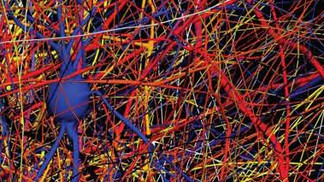
Neuron connexions © Blue Brain EPFL

The Spaun team explains in their paper published last week in Science:

…simulating a complex brain alone does not address one of the central challenges for neuroscience: explaining how complex brain activity generates complex behavior. In contrast, we present here a spiking neuron model of 2.5 million neurons that is centrally directed to bridging the brain-behavior gap.

Nature News has a great explanation of how Spaun makes connections, in some ways mirroring the working of the brain itself:

The computing cells are divided into groups, corresponding to specific parts of the brain that process images, control movements and store short-term memories. These regions are wired together in a realistic way, and even respond to inputs that mimic the action of neurotransmitters.

For all its cleverness, Spaun does come with several shortcomings, not surprising given its scale. But it does have its place among models that seek to understanding the brain–after all, given the complexity of that project, it’s all hands on deck. 

What A Wonderful World With David Attenborough -- BBC One

ORIGINAL: BBC ONE


Originally uploaded by the BBC on Dec 7, 2011 on their youtube channel: youtube.com/bbc re uploaded for everyone thats not located in the UK and can't view it there. So, here you go:

Original description
http://www.bbc.co.uk/bbcone/ A celebration of Natural History on BBC One with David Attenborough.


domingo, 23 de diciembre de 2012

Where Earth's Life Lives: Famous Map Gets an Update

Douglas Main, OurAmazingPlanet Staff Writer
Dec 20, 2012

This new global map shows the division of nature into 11 large biogeographic realms and shows how these areas relate to each other. CREDIT: University of Copenhagen 
Alfred Russel Wallace was one of the 19th century's foremost naturalists, independently describing what became the theory of evolution, for which his contemporary Charles Darwin is more widely known. Like Darwin, Wallace was influenced by the creatures he encountered on his travels around the world. From these travels, he made a map of global biodiversity that revolutionized the way people thought about the variety of life on Earth.

Now, the map has been updated to include data from 20,000 species, where they live and how they interact with one another, said Ben Holt, a researcher at Denmark's University of Copenhagen. It allows users to see where just about every species of amphibian, mammal and bird lives, Holt said. The updated map is published today (Dec. 20) in the journal Science.

"The map summarizes all the information we have learned … regarding where species are distributed and how they are related to each other," he told OurAmazingPlanet. "The consistency among the groups is quite striking."


Regions in the Southern Hemisphere tend to have an abundance of unique animal communities, with Australia, Madagascar and South America standing out, he said. The variety of life above the equator is less distinct. It's thought this is because of the relative isolation of the areas south of the equator, as well as their unique habitats and abundance of rain and warm temperatures – ingredients for a wide variety of life. 


The map is made by inputting species distributions onto a gridded globe, producing a species list for every grid cell, which can then be compared with the species lists of other grids, Holt said.

Alfred Russel Wallace is depicted inspecting two globes, representing his own highly influential global biogeographic map from 1876 (upper) and the updated modern version of this map (lower).
CREDIT: Center for Macroecology, Evolution and Climate
The resulting map divides nature into 11 large biogeographic realms and reveals how these areas relate to each other. The map incorporates genetic information that wasn't available in Wallace's day, Holt said. [Amazing Species Discovered in 2012]

The map doesn't yet include data for reptiles, plants or insects, because that information is less complete. But those data can be easily incorporated once they become available, he said.

Alfred Russel Wallace (1823-1913) was a British explorer, scientist and collector whose theories on the distribution of life, or biogeography, laid the foundations for many fields of modern biological science.

"The original Wallace map clearly had a massive and unquantifiable influence on the study of global biodiversity," Holt said. "The new map shows the incredible progress that we have made since Wallace's time and also serves as a reminder that we still know very little about how these patterns [of the distribution of life] were formed."

Reach Douglas Main at dmain@techmedianetwork.com. Follow him on Twitter @Douglas_Main. Follow OurAmazingPlanet on Twitter @OAPlanet. We're also on Facebook and Google+.

Arbitrarily complex 3D DNA nanostructures built from DNA bricks


Computer-generated 3D models (top) and corresponding 2D projection microscopy images (bottom) of nanostructures self-assembled from synthetic DNA strands called DNA bricks. (Image Credit: Yonggang Ke, Wyss Institute, Harvard University.)
This past May we posted news of a major advance in the toolkit for DNA nanotechnology. Researchers led by Wyss Institute core faculty member Peng Yin developed a very versatile, rapid, and inexpensive way to assemble arbitrarily complex 150-nm two-dimensional DNA nanostructures from 42-nucleotide DNA tiles. A hat tip to ScienceDaily for reprinting this Wyss Institute news release of another major advance from the same research group aided by another Wyss Core Faculty member William ShihResearchers Create Versatile 3D Nanostructures Using DNA ‘Bricks’”:

Researchers at the Wyss Institute for Biologically Inspired Engineering at Harvard University have created more than 100 three-dimensional (3D) nanostructures using DNA building blocks that function like Lego® bricks — a major advance from the two-dimensional (2D) structures the same team built a few months ago.

In effect, the advance means researchers just went from being able to build a flat wall of Legos®, to building a house. The new method, featured as a cover research article in the 30 November issue of Science [abstract], is the next step toward using DNA nanotechnologies for more sophisticated applications than ever possible before, such as “smart” medical devices that target drugs selectively to disease sites, programmable imaging probes, templates for precisely arranging inorganic materials in the manufacturing of next generation computer circuits, and more. …

Earlier this year, the Wyss team reported in Nature how they could create a collection of 2D shapes by stacking one DNA brick (42 bases in length) upon another.

But there’s a “twist” in the new method required to build in 3D.

The trick is to start with an even smaller DNA brick (32 bases in length), which changes the orientation of every matched-up pair of bricks to a 90 degree angle — giving every two Legos® a 3D shape. In this way, the team can use these bricks to build “out” in addition to “up,” and eventually form 3D structures, such as a 25-nanometer solid cube containing hundreds of bricks. The cube becomes a “master” DNA “molecular canvas”; in this case, the canvas was comprised of 1000 so-called “voxels,” which correspond to eight base-pairs and measure about 2.5 nanometers in size – meaning this is architecture at its tiniest.

The master canvas is where the modularity comes in: by simply selecting subsets of specific DNA bricks from the large cubic structure, the team built 102 3D structures with sophisticated surface features, as well as intricate interior cavities and tunnels. “This is a simple, versatile and robust method,” says Peng Yin, Ph.D., Wyss core faculty member and senior author on the study.

The DNA-brick technique capitalizes on the ability of DNA strands to selectively attach to other strands, thanks to the underlying “recipe” of DNA base pairs. …

Another method used to build 3D structures, called DNA origami, is tougher to use to build complex shapes, Yin said, because it relies on a long “scaffold” strand of DNA that folds to interact with hundreds of shorter “staple” strands – and each new shape requires a new scaffold routing strategy and hence new staples. In contrast, the DNA brick method does not use any scaffold strand and therefore has a modular architecture; each brick can be added or removed independently.

We are moving at lightning speed in our ability to devise ever more powerful ways to use biocompatible DNA molecules as structural building blocks for nanotechnology, which could have great value for medicine as well as non-medical applications,” says Wyss Institute Founding Director Don Ingber, M.D., Ph.D.

The news release includes a video and an animation showing how the DNA strands self-assemble to build complex 3D objects.
Making Structures with DNA "Building Blocks" from Wyss Institute on Vimeo.

This powerful advance should lead to programmable molecular arrangements for several applications. Any of a great variety of molecular species can be attached to DNA bricks and thus assembled into arbitrarily complex 3D configurations. What sorts of molecular species would give DNA bricks functionality that could be used to build a very primitive nanofactory? Where does this advance stand on the road to molecular manufacturing or productive nanosystems? Back in May of 2005 Chris Phoenix and Tihamer Toth-Fejel authored a report for the NASA Institute for Advanced Concepts (“Large-Product General-Purpose Design and Manufacturing Using Nanoscale Modules“, PDF) in which they proposed two different designs for a very primitive nanofactory based upon planar assembly, each using 5-nm molecular building blocks of unspecified composition, prepared by either chemical synthesis or self-assembly, and incorporating a few simple functional capabilities. Certainly one or more functions could be attached to either these 2.5-nm DNA voxels or the 25-nm larger structures comprising 1000 voxels. Can anyone see a way from this advance to a primitive nanofactory that could be used to build improved nanofactories, leading eventually to molecular manufacturing? 
—James Lewis, PhD

This entry was posted on Thursday, December 6th, 2012 at 12:11 PM and is filed under Atomically Precise Manufacturing (APM),Bionanotechnology, Molecular Nanotechnology, Molecular manufacturing, Nano, Nanobiotechnology, Nanotech,Nanotechnology, Productive Nanosystems, Research. You can follow any responses to this entry through the RSS 2.0 feed. You can leave a response, or trackback from your own site.

Origin of Life: Hypothesis Traces First Protocells Back to Emergence of Cell Membrane Bioenergetics

ORIGINAL: Science Daily

Dec. 20, 2012 — A coherent pathway -- which starts from no more than rocks, water and carbon dioxide and leads to the emergence of the strange bio-energetic properties of living cells -- has been traced for the first time in a major hypothesis paper in Cell this week.

A major new hypothesis outlines a coherent pathway that starts from no more than rocks, water and carbon dioxide and leads to the emergence of the strange bio-energetic properties of living cells. (Credit: iStockphoto/Henrik Jonsson)
At the origin of life the first protocells must have needed a vast amount of energy to drive their metabolism and replication, as enzymes that catalyse very specific reactions were yet to evolve. Most energy flux must have simply dissipated without use.

So where did it all that energy come from on the early Earth, and how did it get focused into driving the organic chemistry required for life?

The answer lies in the chemistry of deep-sea hydrothermal vents. In their paper Nick Lane (UCL, Genetics, Evolution and Environment) and Bill Martin (University of Dusseldorf) address the question of where all this energy came from -- and why all life as we know it conserves energy in the peculiar form of ion gradients across membranes.

"Life is, in effect, a side-reaction of an energy-harnessing reaction. Living organisms require vast amounts of energy to go on living," said Nick Lane.

Humans consume more than a kilogram (more than 700 litres) of oxygen every day, exhaling it as carbon dioxide. The simplest cells, growing from the reaction of hydrogen with carbon dioxide, produce about 40 times as much waste product from their respiration as organic carbon (by mass). In all these cases, the energy derived from respiration is stored in the form of ion gradients over membranes.

This strange trait is as universal to life as the genetic code itself. Lane and Martin show that bacteria capable of growing on no more than hydrogen and carbon dioxide are remarkably similar in the details of their carbon and energy metabolism to the far-from-equilibrium chemistry occurring in a particular type of deep-sea hydrothermal vent, known as alkaline hydrothermal vents.

Based on measured values, they calculate that natural proton gradients, acting across thin semi-conducting iron-sulfur mineral walls, could have driven the assimilation of organic carbon, giving rise to protocells within the microporous labyrinth of these vents.

They go on to demonstrate that such protocells are limited by their own permeability, which ultimately forced them to transduce natural proton gradients into biochemical sodium gradients, at no net energetic cost, using a simple Na+/H+ transporter. Their hypothesis predicts a core set of proteins required for early energy conservation, and explains the puzzling promiscuity of respiratory proteins for both protons and sodium ions.

These considerations could also explain the deep divergence between bacteria and archaea (single celled microorganisms) . For the first time, says Lane, "It is possible to trace a coherent pathway leading from no more than rocks, water and carbon dioxide to the strange bioenergetic properties of all cells living today."


miércoles, 19 de diciembre de 2012

Biomimicry Student Challenge Water Wise


Project Gallery
Enjoy browsing this gallery including all of this year’s submissions. The Finalists will be announced in January.

Click here to view our panel of Judges.