Mostrando entradas con la etiqueta Vuelo. Mostrar todas las entradas

domingo, 2 de febrero de 2014

Scientists Solve the Mystery Behind Flying Snakes

Snakes might look scary, but researchers say most are harmless if left alone. (Photo : Omar Torres-Carvajal et al. CC-BY 3.0)

Scientists have recently discovered the mystery behind these gliding reptiles that carry the ability to fling themselves through the air--otherwise known as flying snakes.

According to study researchers, the serpents are able to drastically alter their body shape and generate energy that gives them the ability to stay aloft.
"The snake is definitely not an intuitive glider. When you look at it, you say: 'that thing should not be able to glide'. And in its normal body configuration that is probably true. "But when it enters the air, when it takes off and jumps and leaps from a branch, it massively transforms its body," said Professor Jake Socha, from Virginia Tech in the US, who carried out the study, according to BBC.

There are only five known species of flying snakes that belong to the genus Chrysopelea, according to background information from the study. Socha notes that as the snakes jump, their bodies flatten out and rotate in such a way that allows motion to increase through a unique cross-sectional shape.

Researchers found that the body of these creatures changed to one that was typically more squashed and concave at the bottom from the cross-section.

To get a better grasp on how their bodies change for this process, researchers also created a plastic copy of the snake's cross-section and placed it in a tank of flowing water to study it further.

"The water flowed over it and we measured the forces on the model and we also visualised the flow movement in the water using lasers and high-speed cameras," Socha added, via the news organization.

Along with future studies, researchers believe these findings could contribute to the future makings of robots that can crawl, climb and even glide.

What do you think?

More information regarding the study can be found via the Journal of Experimental Biology.

ORIGINAL: World Science Report

domingo, 8 de diciembre de 2013

Meet the flying machine that was inspired by a jellyfish


(Video courtesy of Leif Ristroph)
Leif Ristroph wanted to build the “simplest possible” flying machine. The applied mathematician at New York University glued together several tubes of carbon fiber to build this: a sphere with four wings attached to it that propels it as a jellyfish swims.

The flyer is only about eight centimeters in diameter — small enough to fit in the palm of your hand — and its mass is only about two grams, the equivalent of two paper clips.

Half of the mass is the motor, a commercially available component about the size of the vibrator in a phone. There’s no battery on board. For the time being, the flying jellyfish is tethered to a power cord.
(Photo courtesy of Leif Ristroph)
What’s most remarkable about the device, though, is that even though it has absolutely no circuitry and no sensors, it manages to keep itself upright in the air. That’s apparently a physical property of the arrangement of the wings that Ristroph says he can’t fully explain, but he hopes it will allow his prototype to evolve into a new generation of very small and inexpensive drones.

Researchers have built slightly larger machines with impressive stability and control. Raffaello D’Andrea and his team at the Swiss Federal Institute of Technology in Zurich are well known for their robotic athletes,” which have four helicopter rotors. The machines can catch a ball and perform other autonomous feats of balance and coordination.

The problem is that conventional propellers are ineffective at small scales, Ristroph explains. Other groups have tried to mimic birds and insects, designing robots with wings that flap. The Harvard Microrobotics Laboratory has built a device even tinier than Ristroph’s that resembles a three-legged mosquito.

Ristroph, though, wanted to try something different. “My initial thinking was basically, ‘Okay, insects beat their wings like this. Birds beat their wings like that. Everyone else is building their robots to copy that,’ ” he said. “Let me think of new ways to fly.

He and his colleague, Stephen Childress, have considered a number of outlandish designs, including a machine with a single, conical wing that Ristroph believes could theoretically keep a machine aloft.

The flying jellyfish was particularly exciting. 

The device would right itself in response to disturbances. Flying machines modeled on insects typically require a computer on board or fins of some kind to maintain their stability, but Ristroph wanted to do away with all of those systems entirely. Doing so would make the machine lighter, which in principle would allow for an even smaller motor and a cheap, miniature drone.


Of course, any practically useful version of the jellyfish would have to carry a small battery and a navigation system — right now, all the navigation controls are manual — but Ristroph is optimistic those problems could be solved.
(Photo courtesy of Leif Ristroph)
A more difficult problem is explaining the machine’s stability in the air. It will wobble and flit back and forth in flight, like a moth, but never stalls. Each deviation is compensated for somehow, and the jellyfish stays aloft.

Ristroph wrote a list of formulas to account for the device’s behavior, but he didn’t find them persuasive.

The assumptions I make in the model don’t seem to be justified,” he said. It’s a concession you don’t often hear from researchers.

He envisions flying jellyfish that cost 50 cents each. They could be deployed to monitor air quality, or they could just be disposable toys. “If someone steps on it, it’s fine,” he said.

He isn’t particularly excited about the possibility of a version of his jellyfish being used by the military, and he isn’t comfortable with the Obama administration’s use of drones. But, he said, “Having good drones could, overall, save lives also. I know it’s a big, thorny issue.”

Ristroph demonstrated the device at a conference Sunday, and he’s hoping other researchers will help him figure out why it works.

ORIGINAL: Washington Post
By Max Ehrenfreund
November 25 at 8:20 am

lunes, 22 de abril de 2013

Roboticists discover the secret of insect flight, and it's not wings

ORIGINAL: IO9

Top image via Jon Dhyr.
When it comes to insect flight, we usually only think about how the insect's wings contribute to aerial stability. But scientists have now discovered that the abdominal movements of some insects also play a large role in flight control, particularly when hovering — a finding that could lead to improved aerial drones. 


Scientists often take cues from nature when building robots. And given that an insect's wings provide the lift and thrust forces necessary for flight, they've been the focus of a lot of research. But biologists have long wondered if insects also use their abdomens to help with flight control. After all, numerous studies have documented tethered insects making exaggerated abdominal movements in response to changes in their visual environment. 

Some scientists have speculated that the insects employ their abdomens, which make up a good portion of their bodies, as steering rudders. That is, by moving their abdomens in one direction or another, insects can increase the drag forces on parts of their bodies, helping them to turn. Alternatively, an insect may move its abdomen during flight to shift its center of mass relative to its center of lift, creating a moment of inertia that essentially counteracts the rotation the insect may be experiencing from, say, a gust of wind. 

But nobody has ever tested whether either of these theories is true, or if the observed abdominal movements are merely a result of being tethered. So a group of biologists and engineers set out to do just that.


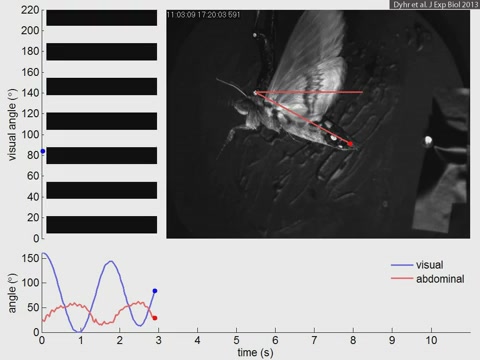
They began by tethering a hawkmoth (Manduca sexta) into a circular flight arena and surrounding it with an LED display system. They created a grating pattern of green and black bars on the screen (seen in the image above), and rotated the pattern up and down. 

"If you were to see something like this in a movie theatre, you would get that funny feeling that you were rotating in the opposite direction as the lights," says study researcher Noah Cowan, an engineer at Johns Hopkins University. "We basically built a little IMAX theatre for the moth to give it the sensation that it's moving around.

They presented the moth with two different types of pattern oscillations, or modes. In one mode, the pattern oscillated with increasing frequency, giving the moth the impression that it was tumbling at an accelerated rate. The other mode was "pseudo-random," where the pattern oscillated at different speeds and degrees. 

They found that the moth moved its abdomen in direct response to its shifting visual environment. "If the pattern is rotating up (clockwise), the moth would raise its abdomen up (counterclockwise)," says study co-author Jonathan Dyhr, a University of Washington biologist. "The moth was raising or lowering its abdomen to counteract the movement."


The moth moves its abdomen in response to the rotation of the grating pattern (which makes it feel as if its falling forward or backward). Credit: Jon Dhyr 
Importantly, the moth tuned its abdominal movements to the different specific oscillations, with larger pattern movements resulting in larger abdominal movements (as you can see in the videos). "It has a very stereotyped dynamical response," Cowan told io9, adding that these responses allowed the team to mathematically model the moth's behavior and accurately predict how it would respond to different oscillations

With their observations and their model, the researchers determined that the moths use their abdomens for flight control via two mechanisms. First, the abdominal movements shift the moth's center of mass relative to the center of lift, counteracting the rotation, as previously theorized. Additionally, when the moth rotates its abdomen, its thorax rotates in the opposite direction to conserve angular momentum — this causes the aerodynamic forces produced by the wings, which are attached the thorax, to redirect, helping to correct the loss of stability. 

Dyhr notes that the team didn't disprove the rudder theory. They really only looked at the case of hovering, so the moths may still use their abdomens as rudders when flying forward. The researchers also suggest that other insects probably use this technique as well (though smaller insects will find it less effective). 

A quadrotor the team built. Note its dangling battery, which functions in a similar way to the moth's abdomen. Credit: Alican Demir. 
A real-life swarm of flying robots, right out of a 1980s arcade game

Cowan says that their discovery could improve the stability of aerial robots — in fact, the team has already demonstrated its use in a robotic quadrotor. These flying drones have four propellers controlled by four independent motors, all of which are powered by an attached battery. The scientists unmounted the battery, hung it below the quadrotor and implemented a sensor and control system that automatically adjusted the position of the battery in response to the robot's pitch. Similar to the moth, when the robot moved its battery, the aerodynamic forces from the propellers redirected, resulting in increased stability (see the video below). 

The researchers essentially gave the robot's battery a second function. "In engineering, people tend to focus on 'one part, one function,' but in bio

The moth moves its abdomen in response to the rotation of the grating pattern (which makes it feel as if its falling forward or backward). Credit: Jon Dhyr 
logy you see these incredibly complex, integrated systems." Cowan says. "The lesson to learn here is the incredible success that nature has in adapting designs to take advantage of and exploit multifunctionality." 

The new design allows the quadrotor to stabilize itself after being knocked around. Credit Alican Demir. 

The researchers detailed their work in a recent study in the Journal of Experimental Biology


lunes, 28 de enero de 2013

Eosinopteryx, el dinosaurio que desafía la teoría evolutiva de las aves

ORIGINAL: Ecoticias
ECOTICIAS.COM / RED / AGENCIAS, 
28/01/2013

Durante muchos años, ha sido aceptado entre los paleontólogos que las aves evolucionaron a partir de un grupo de dinosaurios terópodos desde el período Cretácico Inferior de la historia de la Tierra, hace alrededor de 120-130 millones de años.

Eosinopteryx

El descubrimiento de una nueva ave-dinosaurio del periodo Jurásico desafía las teorías aceptadas sobre el origen del vuelo. Con la participación del doctor Gareth Dyke, profesor titular de Paleontología de Vertebrados de la Universidad de Southampton, en el documento se describe un nuevo dinosaurio emplumado de unos 30 centímetros de longitud, que es anterior a los dinosaurios similares a las aves, de los que se creía habían evolucionado los actuales pájaros.

Durante muchos años, ha sido aceptado entre los paleontólogos que las aves evolucionaron a partir de un grupo de dinosaurios terópodos desde el período Cretácico Inferior de la historia de la Tierra, hace alrededor de 120-130 millones de años. Los recientes descubrimientos de dinosaurios emplumados de la Edad Media tardía en el período Jurásico han reforzado esta teoría.

La nueva ave-dinosaurio Eosinopteryx descrita en Nature Communications esta semana proporciona una evidencia adicional en este sentido.

"Este descubrimiento arroja dudas sobre la teoría de que el famoso fósil de Archaeopteryx - o 'primer pájaro', como se denomina a veces - fue fundamental en la evolución de las aves modernas", dice el doctor Dyke, que trabaja en el Oceanographic National Centre, en Southampton."Nuestros hallazgos sugieren que el origen del vuelo fue mucho más complejo de lo que se pensaba."

Los restos fosilizados encontrados en el noreste de China indican que, si bien estaban emplumados, no se trataba de un dinosaurio volador, por su envergadura pequeña y una estructura ósea que había restringido su capacidad de batir sus alas.

El dinosaurio también tenía los dedos adecuados para caminar por el suelo y un menor número de plumas en la cola y las piernas, lo que le habría hecho más fácil correr. .


lunes, 1 de octubre de 2012

How Bird Wings Work

ORIGINAL: Smarter Every Day


I hope you never look at a bird in flight the same way again. I know I won't!

If I could change anything about this video I would say the word "Situation" less. This is one of the perils of talking to you directly and having no script. I think the authentic conversation with you is worth sounding like a dummy every once an a while!
~~~~~~~~~~~~~~~~~~~~~~~~~~~~~~~~~~~~~
SMARTER EVERY DAY - DEEP DIVE #2