Mostrando entradas con la etiqueta High Speed. Mostrar todas las entradas

viernes, 7 de abril de 2017

Scientists Have Created an Artificial Synapse That Can Learn Autonomously

Sergey Tarasov/Shutterstock
Developments and advances in artificial intelligence (AI) have been due in large part to technologies that mimic how the human brain works. In the world of information technology, such AI systems are called neural networks.

These contain algorithms that can be trained, among other things, to imitate how the brain recognises speech and images. However, running an Artificial Neural Network consumes a lot of time and energy.

Now, researchers from the National Centre for Scientific Research (CNRS) in Thales, the University of Bordeaux in Paris-Sud, and Evry have developed an artificial synapse called a memristor directly on a chip.

It paves the way for intelligent systems that required less time and energy to learn, and it can learn autonomously.

In the human brain, synapses work as connections between neurons. The connections are reinforced and learning is improved the more these synapses are stimulated.

The memristor works in a similar fashion. It's made up of a thin ferroelectric layer (which can be spontaneously polarised) that is enclosed between two electrodes.

Using voltage pulses, their resistance can be adjusted, like biological neurons. The synaptic connection will be strong when resistance is low, and vice-versa.

Figure 1
(a) Sketch of pre- and post-neurons connected by a synapse. The synaptic transmission is modulated by the causality (Δt) of neuron spikes. (b) Sketch of the ferroelectric memristor where a ferroelectric tunnel barrier of BiFeO3 (BFO) is sandwiched between a bottom electrode of (Ca,Ce)MnO3 (CCMO) and a top submicron pillar of Pt/Co. YAO stands for YAlO3. (c) Single-pulse hysteresis loop of the ferroelectric memristor displaying clear voltage thresholds ( and ). (d) Measurements of STDP in the ferroelectric memristor. Modulation of the device conductance (ΔG) as a function of the delay (Δt) between pre- and post-synaptic spikes. Seven data sets were collected on the same device showing the reproducibility of the effect. The total length of each pre- and post-synaptic spike is 600 ns.
Source: Nature Communications
The memristor's capacity for learning is based on this adjustable resistance.

AI systems have developed considerably in the past couple of years. Neural networks built with learning algorithms are now capable of performing tasks which synthetic systems previously could not do.

For instance, intelligent systems can now compose music, play games and beat human players, or do your taxes. Some can even identify suicidal behaviour, or differentiate between what is lawful and what isn't.

This is all thanks to AI's capacity to learn, the only limitation of which is the amount of time and effort it takes to consume the data that serve as its springboard.

With the memristor, this learning process can be greatly improved. Work continues on the memristor, particularly on exploring ways to optimise its function.

For starters, the researchers have successfully built a physical model to help predict how it functions.

Their work is published in the journal Nature Communications.


ORIGINAL: ScienceAlert
DOM GALEON, FUTURISM
7 APR 2017

martes, 17 de marzo de 2015

Carbon3D Unveils Breakthrough CLIP 3D Printing Technology, 25-100X Faster


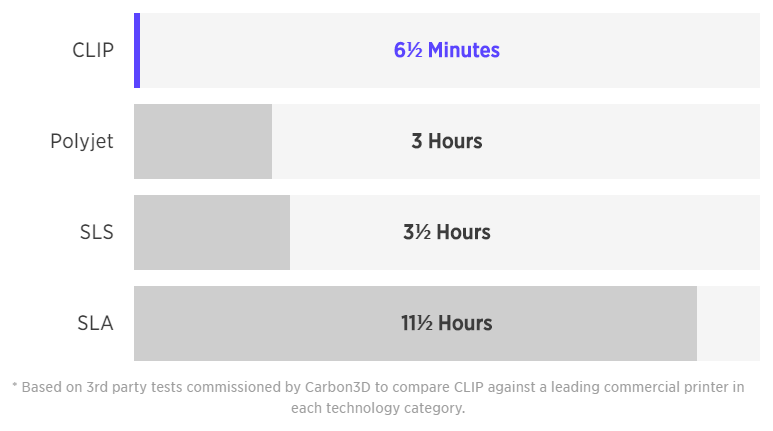
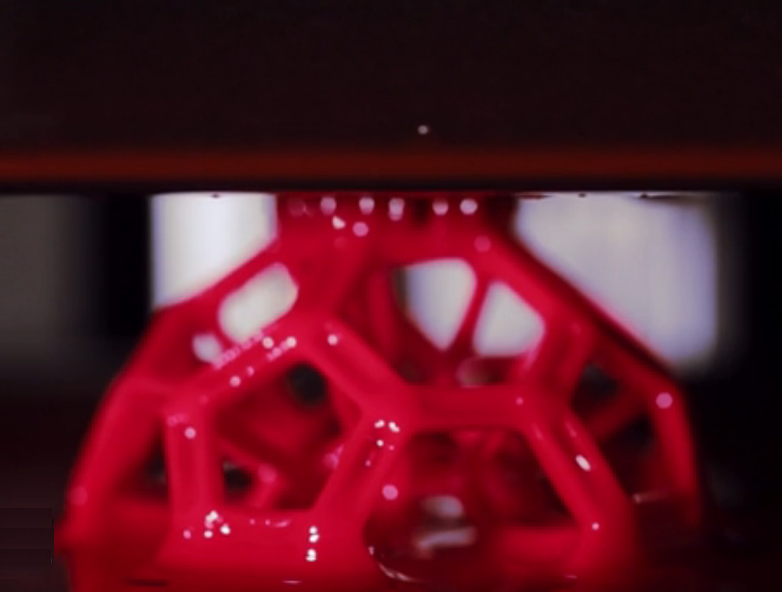
In what may be one of the biggest stories we have covered this year, a new company, Carbon3D has just emerged out of stealth mode, unveiling an entirely new breakthrough 3D printing process, which is anywhere between 25 and 100 times faster than what’s available on the market today.

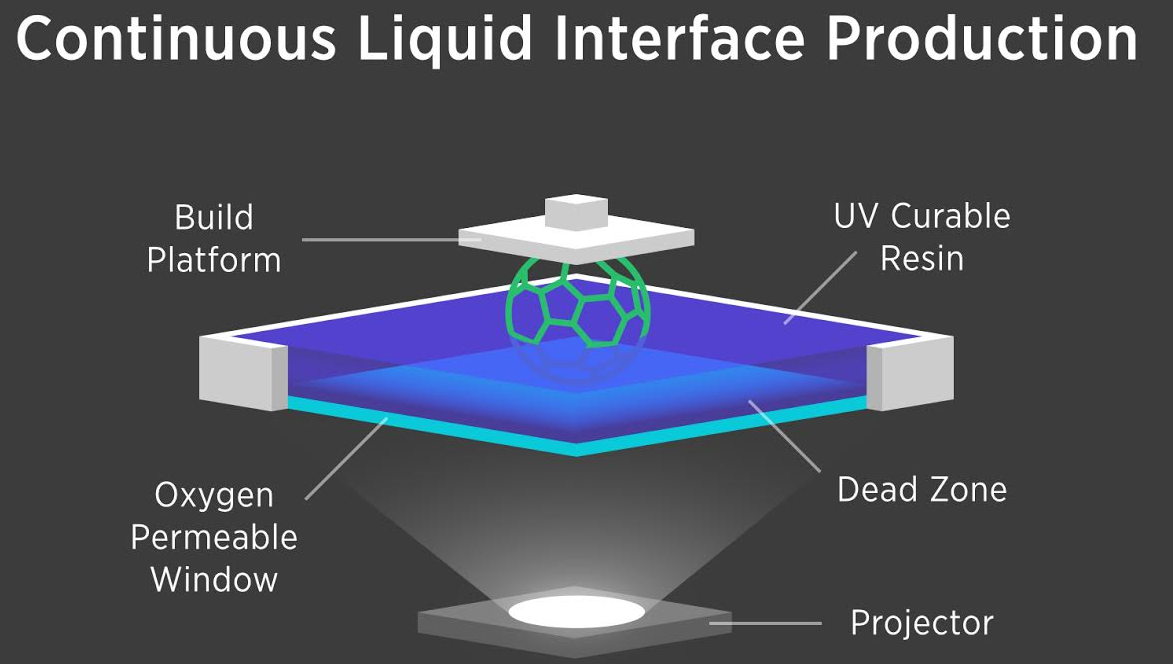
The privately-held Redwood City, California-based company, Carbon3D, was founded in 2013, and since then has been secretly perfecting a new 3D printing technology which promises to change the industry forever. The technology that the company calls Continuous Liquid Interface Production technology (CLIP) works by harnessing the power of light and oxygen to cure a photosensitive resin. Sounds an awful lot like Stereolithography (SLA) technology, doesn’t it? While it uses principles we see within a typical SLA process, where a laser or projector cures a photosensitive resin, Carbon3D’s CLIP process strays greatly from the technology that we are all used to seeing.

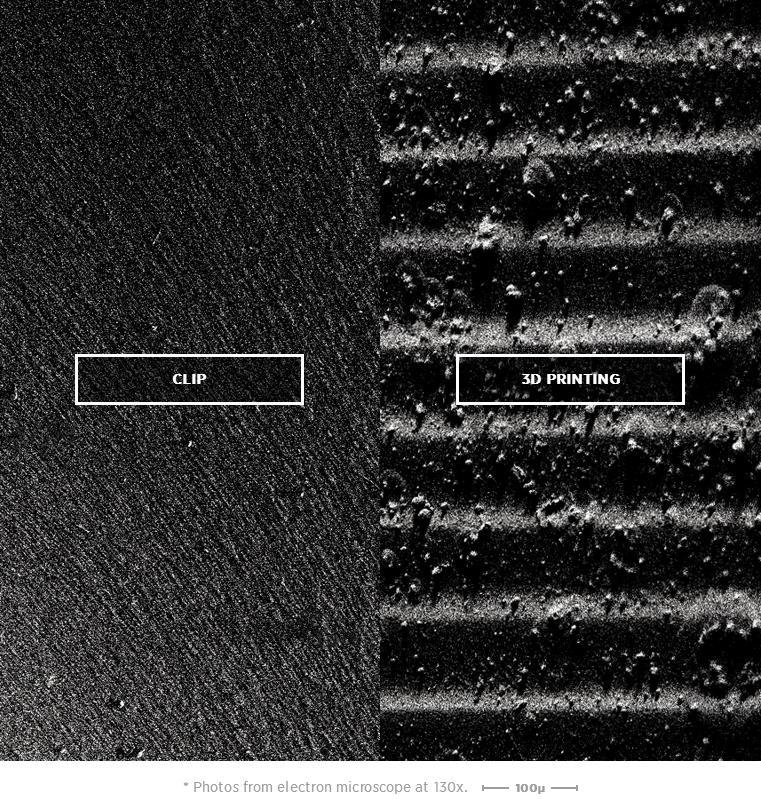
Instead of printing an object layer-by-layer, which leads to incredibly slow speeds as well as a weak overall structure similar to that of shale, this new process harnesses 

  • light as a way to cure the resin, and 
  • oxygen as an inhibiting agent, to print in true 3-dimensional fashion.

“Current 3D printing technology has failed to deliver on its promise to revolutionize manufacturing,” said Dr. Joseph DeSimone, CEO and Co-Founder, Carbon3D. “Our CLIP technology offers 

  • the game-changing speed, 
  • consistent mechanical properties and 
  • choice of materials required for complex commercial quality parts.”
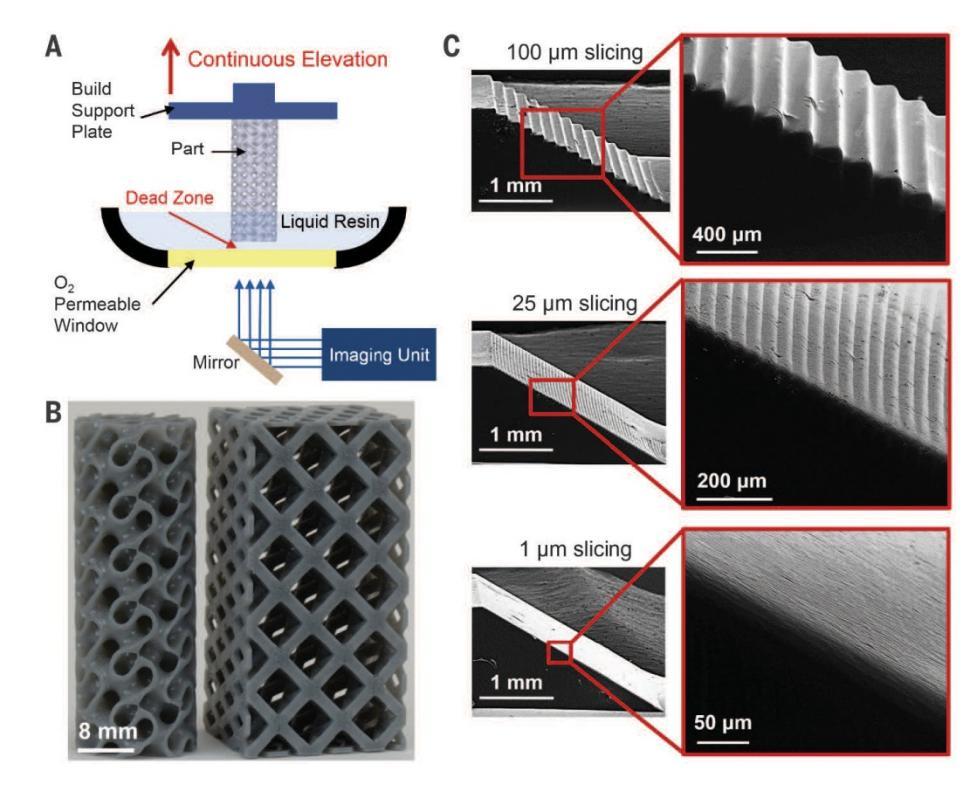
By bringing oxygen into the equation, a traditionally mechanical technique for 3D printing suddenly becomes a tunable photochemical process which rapidly decreases production times, removes the layering effect, and provides a technology which may just take 3D printing to the next level. The CLIP process relies on a special transparent and permeable window which allows both light and oxygen to get through. Think of it as a large contact lens. The machine then is able to control the exact amount of oxygen and when that oxygen is permitted into the resin pool. The oxygen thus acts to inhibit the resin from curing in certain areas as the light cures those areas not exposed to the oxygen. Thus the oxygen is able to create a ‘dead zone’ within the resin which is as small as tens of microns thick (about the diameter of 2-3 red blood cells). In this subsection of the resin, it is literally impossible for photopolymerization to take place. The machine will then produce a series of cross sectional images using UV light in a fashion similar to playing a movie.


For those of you who are thinking right now, “This company must be a fluke. After all, how could they have created such a breakthrough 3D printing technique but we’ve yet to hear a peep from them,” the next tidbit of information will certainly diminish your doubts.

Carbon3D has managed to partner with Sequoia Capital, one of the oldest and most successful venture capital firms on the planet, to lead their Series A round of financing in 2013, and with Silver Lake Kraftwerk for their Series B round. In total, they have raised $41 million to date, all practically under the radar.


“If 3D printing hopes to break out of the prototyping niche it has been trapped in for decades, we need to find a disruptive technology that attacks the problem from a fresh perspective and addresses 3D printing’s fundamental weaknesses,” said Jim Goetz, Carbon3D board member and Sequoia partner. “When we met Joe and saw what his team had invented, it was immediately clear to us that 3D printing would never be the same.”

The CLIP process was originally developed by the company’s CEO, Joseph DeSimone, along with his colleagues Professor Edward Samulski, and Dr. Alex Ermoshkin. It’s going to be very interesting to see just how this technology ultimately plays out, and when it may come to market. Now that the company is out of stealth mode, will the larger players within the space try acquiring them? Let’s hear your thoughts on this breaking story in the Carbon3D forum thread on 3DPB.com

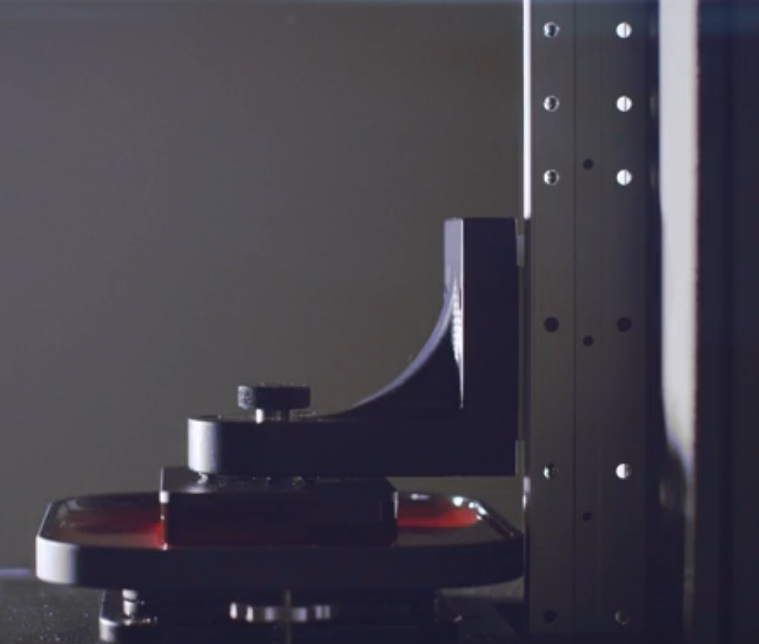
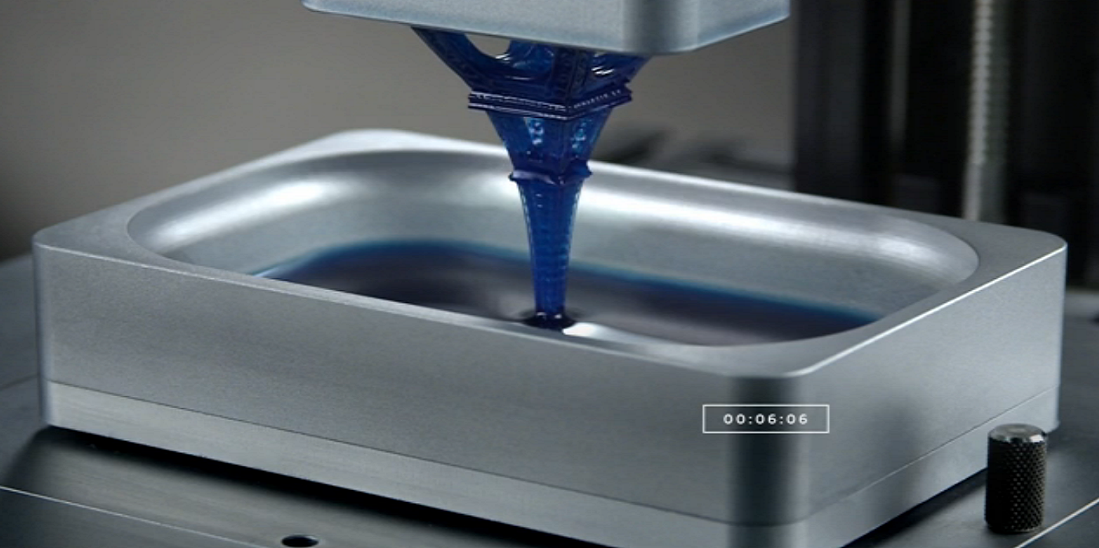
(image source: sciencemag.org)

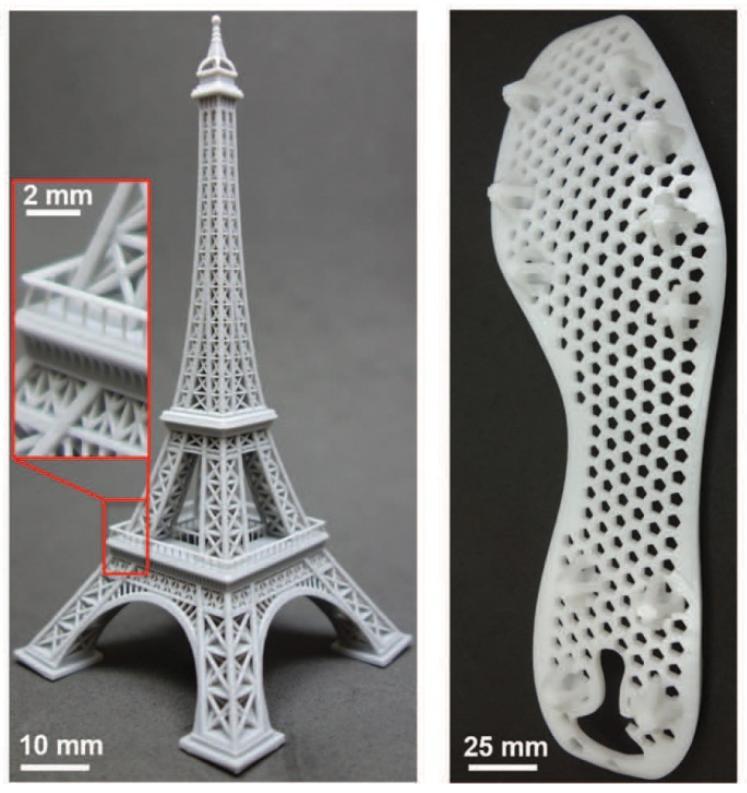
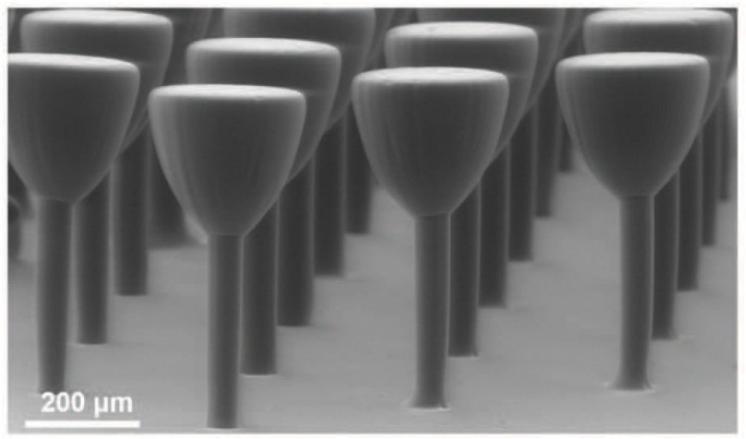
(image source: sciencemag.org)

clip6

ORIGINAL: 3D Print
BY BRIAN KRASSENSTEIN
MARCH 16, 2015

domingo, 30 de septiembre de 2012

1,000,000,000,000 Frames/Second Photography - Ramesh Raskar

ORIGINAL: TED

Photo: TED
Ramesh Raskar presents femto-photography, a new type of imaging so fast it visualizes the world one trillion frames per second, so detailed it shows light itself in motion. This technology may someday be used to build cameras that can look “around” corners or see inside the body without X-rays.

Photography is about creating images by recording light. At the MIT media lab, professor Ramesh Raskar and his team members have invented a camera that can photograph light itself as it moves at, well, the speed of light.

Photography is about creating images by recording light. At the MIT media lab, professor Ramesh Raskar and his team members have invented a camera that can photograph light itself as it moves at, well, the speed of light.

Why you should listen to him:

In 1964 MIT professor Harold Edgerton, pioneer of stop-action photography, famously took a photo of a bullet piercing an apple using exposures as short as a few nanoseconds. Inspired by his work, Ramesh Raskar and his team set out to create a camera that could capture not just a bullet (traveling at 850 meters per second) but light itself (nearly 300 million meters per second).

Stop a moment to take that in: photographing light as it moves. For that, they built a camera and software that can visualize pictures as if they are recorded at 1 trillion frames per second. The same photon-imaging technology can also be used to create a camera that can peer "around" corners , by exploiting specific properties of the photons when they bounce off surfaces and objects.

Among the other projects that Raskar is leading, with the MIT Media Lab's Camera Culture research group, are low-cost eye care devices, a next generation CAT-Scan machine and human-computer interaction systems.

Papers: 
Andreas Velten, Thomas Willwacher, Otkrist Gupta, Ashok Veeraraghavan, Moungi G. Bawendi and Ramesh Raskar, “Recovering Three Dimensional Shape around a Corner using Ultra-Fast Time-of-Flight Imaging.” Nature Communications, March 2012

Andreas Velten, Adrian Jarabo, Belen Masia, Di Wu, Christopher Barsi, Everett Lawson, Chinmaya Joshi, Diego Gutierrez, Moungi G. Bawendi and Ramesh Raskar, "Ultra-fast Imaging for Light in Motion" (in progress). http://femtocamera.info

"Though photographs in the near future will still be composed by people holding cameras, it will gradually become more accurate to say pictures were computed rather than 'taken' or 'captured.'"

Popular Photography magazine