Mostrando entradas con la etiqueta PNNL. Mostrar todas las entradas

viernes, 17 de junio de 2016

Nanorods could harvest water in dry climates

The accidental discovery holds on to water until you don't need it.
S. Nune et al/PNNL, Flickr
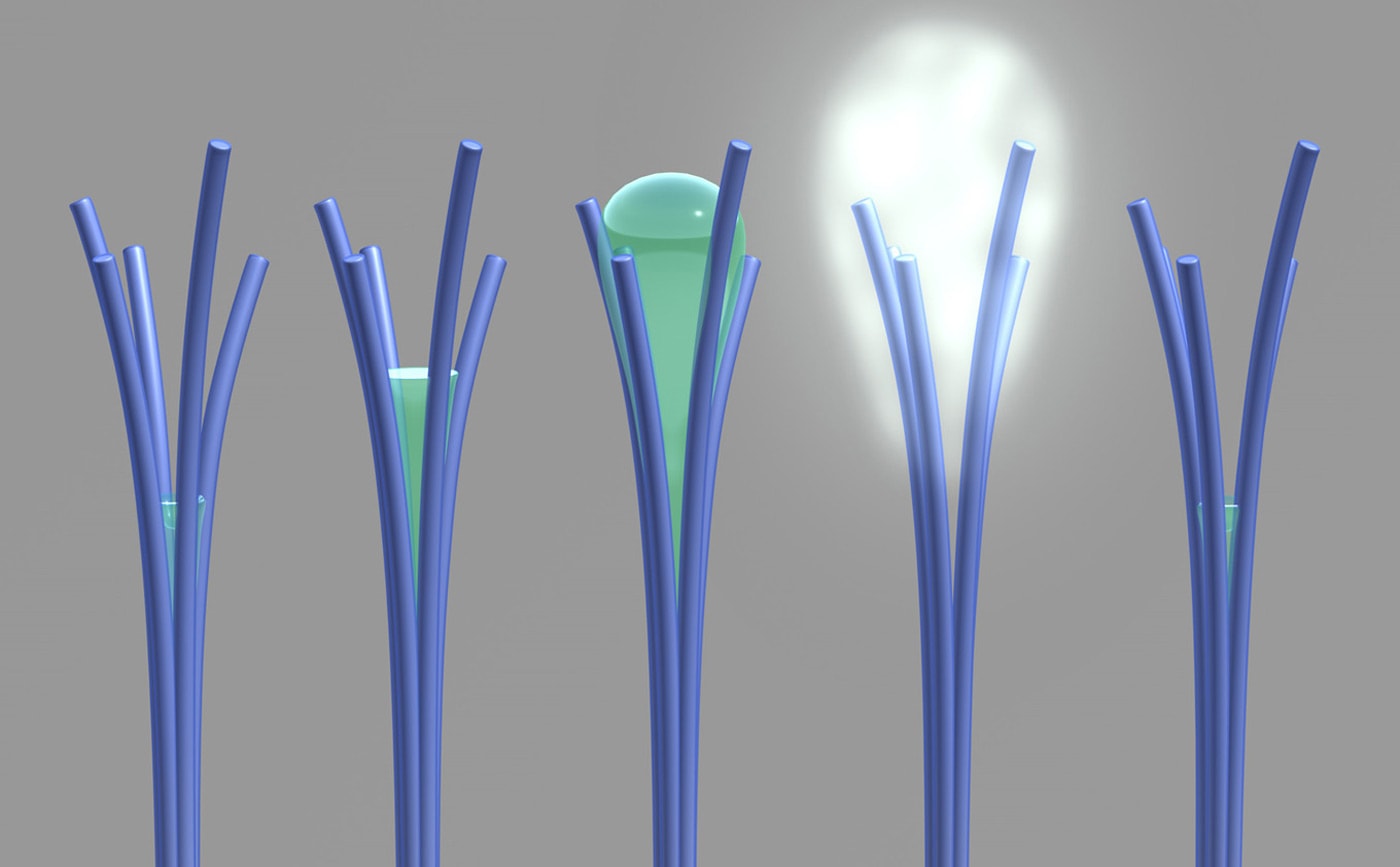
Sometimes it's the accidental discoveries that make the biggest impact. Researchers at Pacific Northwest National Laboratory have learned that carbon-rich nanorods created in a botched experiment might be ideal for harvesting water. When there's relatively low humidity (below 50 percent), the rods trap water inside their gaps; if it's any more humid, however, they promptly expel that water as vapor. It's a very unusual trait that's likely caused by water condensing into a "bridge" in the nanorods, whose surface tension forces them to close and eventually kick the water out.

If scientists can refine the shape of these nanorods and get them to spray water on a consistent basis (only 10 to 20 percent do that right now), the implications are huge. They'd be ideal for harvesting and purifying water in dry climates -- you could gather ambient moisture until there's enough to drink. Alternately, you could use it for anti-sweat clothing that soaks up your perspiration and spits it outside. All told, you'd have direct control over just when and how you get water.

Via: Gizmag
Source: PNNL

ORIGINAL: Engadget
06.14.16

miércoles, 4 de septiembre de 2013

New catalyst dives into water to produce hydrogen

ORIGINAL: DOE Pulse

Scientists designed a nickel complex that quickly and efficiently catalyzes the production of hydrogen in the presence of water.


Few catalysts are energy efficient, highly active, stable, and operate in water, but a nickel-based catalyst designed at the Center for Molecular Electrocatalysis at DOE’s Pacific Northwest National Laboratory quickly produces hydrogen molecules in solutions with 75 percent water. This catalyst contains tailored relays that allow the catalyst to quickly shuttle protons from the solution to the heart of the catalyst, where they are added to electrons.

The catalyst is known to be energy efficient, stable and highly active. With the modified design, it now operates in water, producing up to 170,000 hydrogen molecules per second. The study on this catalyst appeared on the cover and was highlighted as a hot article in Chemical Communications.

"We've moved from pure organic solvents to solutions with increasing amounts of water," said Dr. Monte Helm, Deputy Director of the Center for Molecular Electrocatalysis, an Energy Frontier Research Center. "We found that our catalyst performed better with water than in an organic solvent alone."

Working efficiently in water is key for catalysts that could take electrons generated by solar panels and combine them with protons to create molecular hydrogen, storing the energy for later use. This new catalyst answers fundamental questions about how to design catalysts in the laboratory and eventually in the real world. "We are getting closer to what we need for a real-world catalyst," said Dr. Morris Bullock, Director of the Center for Molecular Electrocatalysis.

This work was funded by the Center for Molecular Electrocatalysis, an Energy Frontier Research Center funded by DOE’s Office of Basic Energy Sciences.


[Kristin Manke, 509.372.6011,
kristin.manke@pnnl.gov]