Mostrando entradas con la etiqueta Electrostática. Mostrar todas las entradas

lunes, 16 de diciembre de 2013

SOFS Take to Water. Researchers at Berkeley Lab’s Molecular Foundry Create First Soluble 2D Supramolecular Organic Frameworks

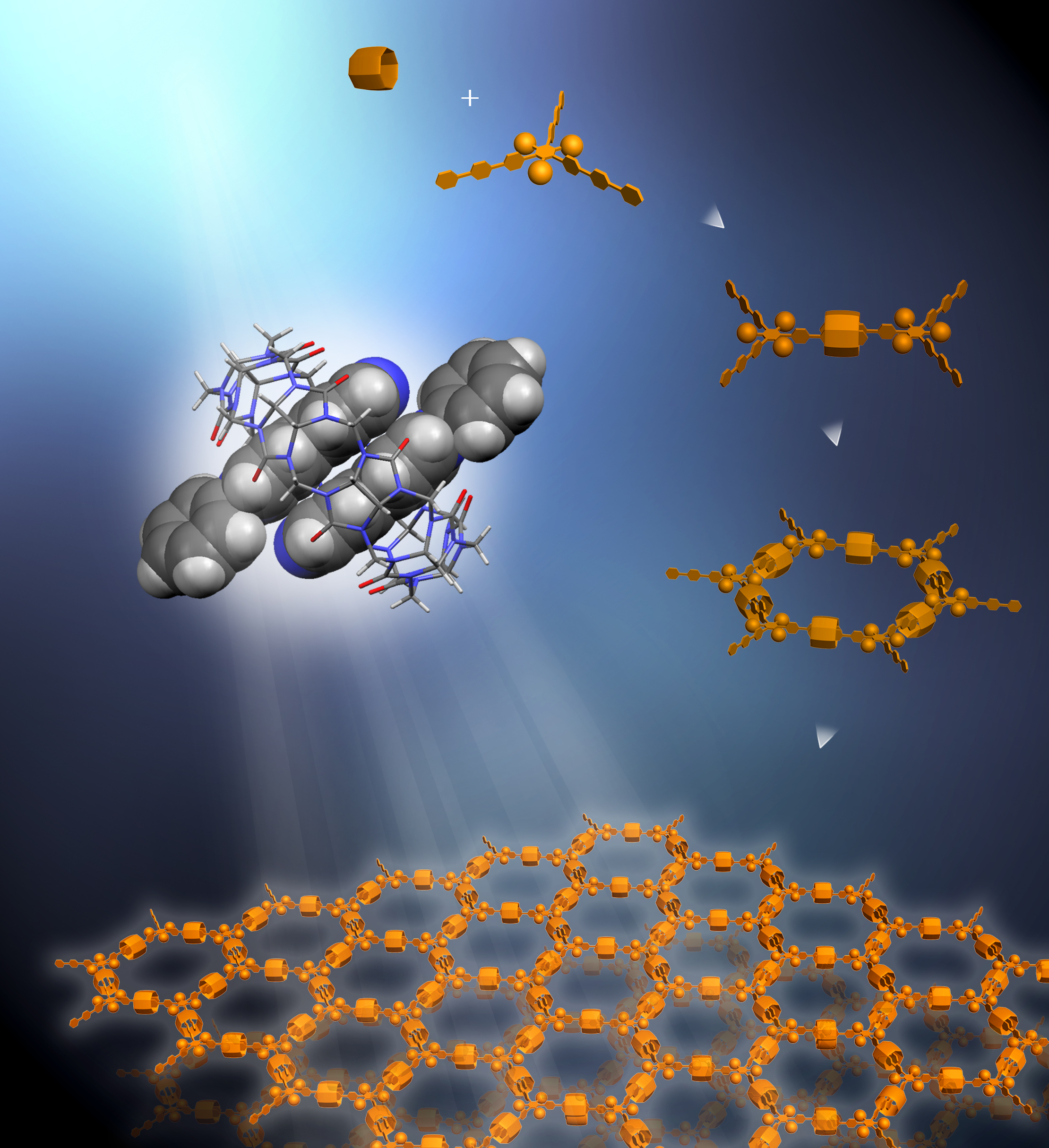
Rigid triangular struts self-assemble in combination with macrocycle rings in solution to create a supramolecular organic framework (SOF). Each strut contains functional units that resist stacking to maintain the 2D framework in a single layer.

Supramolecular chemistry, aka chemistry beyond the molecule, in which molecules and molecular complexes are held together by non-covalent bonds, is just beginning to come into its own with the emergence of nanotechnology. Metal-organic frameworks (MOFs) are commanding much of the attention because of their appetite for greenhouse gases, but a new player has joined the field – supramolecular organic frameworks (SOFs). Researchers with the U.S. Department of Energy (DOE)’s Lawrence Berkeley National Laboratory (Berkeley Lab) have unveiled the first two-dimensional SOFs that self-assemble in solution, an important breakthrough that holds implications for sensing and separation technologies, energy sciences, and, perhaps most importantly, biomimetics.

“We’ve demonstrated the first soluble single-layer 2D honeycomb SOF that combines the ordering and porous features of MOFs with the solubility of supramolecular polymers,” says Yi Liu, a chemist with Berkeley Lab’s Materials Sciences Division. “The results prove that we can exercise precise control of dimensionality within structures through a solution-based supramolecular approach, which paves the way for the assembly of more advanced architectures that can be processed in solution.”

Liu, who oversees the supramolecular electronics research group at Berkeley Lab’s Molecular Foundry, a DOE national nanoscience user facility, is one of three corresponding authors of a paper describing this research in the Journal of the American Chemical Society (JACS). The paper is titled “Toward a Single-Layer Two-Dimensional Honeycomb Supramolecular Organic Framework in Water.” The other corresponding authors are Xin Zhao and Zhan-Ting Li, of China’s Shanghai Institute of Organic Chemistry and Fudan University.
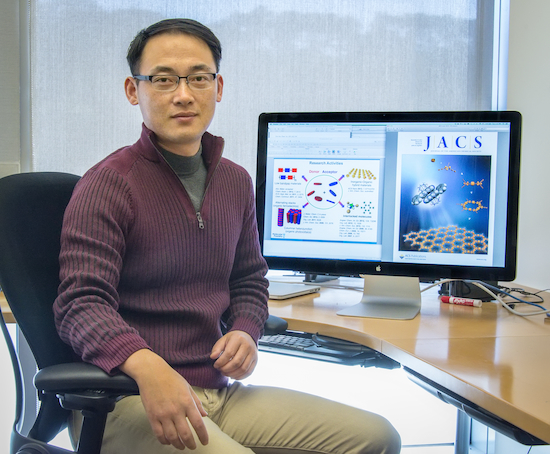

Yi Liu at the Molecular Foundry. (Photo by Roy Kaltschmidt)
Traditional molecular chemistry involves the strong covalent bonds formed by the sharing or exchange of electrons between the atoms that make up a molecular system. Supramolecular chemistry involves systems that are held together by a multitude of weaker, non-covalent connections, such as hydrogen bonds and electrostatic and Van der Waals forces. Nature uses supramolecular chemistry to form the double-helix of DNA or to fold proteins. For nanotechnology, single-layers of 2D structurally ordered materials – along the lines of graphene – could fill a great many needs but the key is to process them in solution.

“Solution-based processing allows for mass production and reduced manufacturing costs, and is an important step for transferring materials to a dry state without losing their structural integrity,” Yi says. “Solution-based processing also allows for bio-related applications such as biomimetic sensing, where the framework structure is advantageous for the capturing of guest molecules and the amplification of chemical signals.”
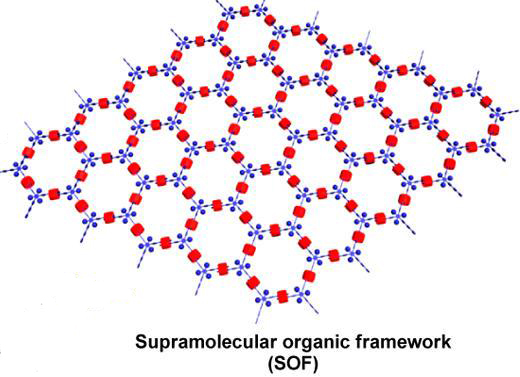

SOFs feature a porous framework with honeycomb periodicity similar to a MOF.

However, the self-assembly of well-defined 2D supramolecular systems polymers in solution has been a challenge because such polymers tend to precipitate out of solution, making them difficult to manipulate and characterize. To meet this challenge, Yi and his collaborators used a combination of self-assembling tripods and macrocycle rings to form a porous framework with honeycomb periodicity, similar to that of a MOF, but which remains rigid in solution. Equipping the tripods with bulky hydrophilic groups that resist stacking preserved the solubility and single-layer 2D architecture of the framework.

“That our framework is held together by reversible, non-covalent supramolecular interactions ensures good solubility in water,” Li says. “The precise dimensional control of our solution-based processing facilitates the structural and chemical customization of our frameworks.”

The tripods of these SOFs were made from aromatic bipyridine molecules whose trio of struts or arms were interlocked with the struts of their neighboring molecules through the macrocycles, which were made from cucurbituril molecules. The molecules used in this study were proof-of-principle starters. Other molecules for the struts could be employed in the future for the design of similar or more complex architectures. The 2D single-layer structures of these first SOFs were characterized at Berkeley Lab’s Advanced Light Source, another DOE national user facility, using small angle X-ray scattering (SAXS) technologies at beamlines 12.3.1 and 7.3.3.

Yi and his collaborators at the Molecular Foundry and in Shanghai are now working to create soluble SOFs in 3D. In addition to the corresponding authors, other authors of the JACS paper were Kang-Da Zhang, Jia Tian, David Hanifi, Yuebiao Zhang, Andrew Chi-Hau Sue, Tian-You Zhou and Lei Zhang.

This research was supported by the DOE Office of Science.

Additional Information

For more about the research of Yi Liu go here
For more about the Molecular Foundry go here
For more about the Advanced Light Source go here

# # #

Lawrence Berkeley National Laboratory addresses the world’s most urgent scientific challenges by advancing sustainable energy, protecting human health, creating new materials, and revealing the origin and fate of the universe. Founded in 1931, Berkeley Lab’s scientific expertise has been recognized with 13 Nobel prizes. The University of California manages Berkeley Lab for the U.S. Department of Energy’s Office of Science. For more, visit www.lbl.gov.

DOE’s Office of Science is the single largest supporter of basic research in the physical sciences in the United States, and is working to address some of the most pressing challenges of our time. For more information, please visit the Office of Science website at science.energy.gov/.
TAGS: energy, material science, Materials Sciences Division, Molecular Foundry, nanoscience, nanotechnology


ORIGINAL: Berkeley Labs
Lynn Yarris (510) 486-5375 lcyarris@lbl.gov 
December 16, 2013

jueves, 24 de enero de 2013

Breaking the bacteria barrier

ORIGINAL: IBM

The Research Team (from left to right): Dr James L. Hedrick, IBM Research, Dr Yi-Yan Yang, IBN Group Leader, Dr Shaoqiong Liu, IBN Research Scientist, Dr Jeremy Tan, IBN Research Scientist and Li Yan, IBN PhD Candidate.
Bacterial biofilms appearing on the skin and on medical devices and household surfaces are difficult to treat and demonstrate high resistance to antibiotics. Antimicrobial hydrogels developed by IBM Research and the Institute for Bioengineering and Nanotechnology demonstrate 100% efficiency in destruction of these biofilms, with application potential for catheter and medical device coatings, implants, skin and everyday surfaces.

New hydrogel born from semiconductor research may help save lives

We are obsessed with cleanliness. From anti-bacterial cart wipes at the supermarket to individual sized packages of wipes and gels that we can carry in a pocket or a purse - you'd think we were winning in the war against germs.

But in hospitals, clinics and other medical facilities, the potential for infection still exists. Despite advanced sterilization and aseptic techniques, infections associated with medical devices and surfaces have not been eradicated, thanks to the increase in drug-resistant bacteria.

According to the CDC, antibiotic drug resistance in the U.S. costs an estimated $20 billion a year in healthcare costs as well as 8 million additional days spent in the hospital[1]. And hospital-acquired infections are among the top five leading causes of death in the United States and account for up to $11 billion in healthcare spending each year[2].

And while personal anti-bacterial products exist on the market today in the form of the aforementioned hand gels and wipes, these products target very common germs and most contain ethanol as a key ingredient. Ethanol evaporates after a very short time after application and does not provide long-lasting protection.

Cleaning products that effectively destroy bacteria on surfaces, including alcohol and bleach, also break down and/or evaporate after a short period of time and are not transferrable for human application based on their toxicity.

Now imagine a long-lasting substance that is biocompatible and non-toxic, but also biodegradable. A substance that destroys specific types of bacteria but leaves healthy skin and cells alone – one that could be applied to medical facility surfaces, surgical and diagnostic instruments, and even – one day - medical implants.

IBM Research, in association with the Institute of Bioengineering and Nanotechnology in Singapore have taken a first step towards that future with the development of an antimicrobial hydrogel that can break through diseased biofilms and eradicate drug-resistant bacteria upon contact.

“We were driven to develop a more effective therapy against superbugs due to the lethal threat of infection by these rapidly mutating microbes and the lack of novel antimicrobial drugs to fight them. Using the inexpensive and versatile polymer materials that we have developed jointly with IBM, we can now launch a nimble, multi-pronged attack on drug-resistant biofilms which would help to improve medical and health outcomes.”. Dr Yi-Yan Yang, Group Leader, Institute of Bioengineering and Nanotechnology, Singapore


It began with computer chips
The IBM nanomedicine polymer program began in IBM Research labs only four years ago with the mission to improve human health.

The program itself stems from decades of materials development traditionally used for semiconductor technologies. In earlier chip development research, IBM researchers identified specific materials that, when chained together, produced an electrostatic charge that allows microscopic etching on a wafer to be done at a much smaller scale.

This newfound knowledge that characterization of materials could be manipulated at the atomic level to control their movement inspired the team to see what else they could do with these new kinds of polymer structures. They started with methicillin-resistant Staphylococcus aureus (MRSA).

The outcome of that experiment was the creation of what are now playfully known as "ninja polymers" – sticky nanostructures that move quickly to target infected cells in the body, destroy the harmful content inside, and can then disappear by biodegrading without causing damaging side effects or accumulating in the organs. As a bonus, all of this occurs without damaging healthy cells in the area.

The next step was to figure out how to apply this new capability to other applications to help fight harmful bacteria.
Zipping molecules and zapping bacteria
Through the precise tailoring of polymers, researchers were able to create macromolecules - molecular structures containing a large number of atoms - which combine water solubility, a positive charge, and biodegradability. When mixed with water and heated to normal body temperature, the polymers self-assemble, swelling into a synthetic gel that is easy to manipulate.

“This is a fundamentally different approach to fighting drug-resistant biofilms. When compared to capabilities of modern-day antibiotics and hydrogels, this new technology carries immense potential. This new technology is appearing at a crucial time as traditional chemical and biological techniques for dealing with drug-resistant bacteria and infectious diseases are increasingly problematic.”. James Hedrick, Advanced Organic Materials Scientist, IBM Research

This capability stems from internal reactions that create a molecular "zipper" effect. Similar to how zipper teeth link together, the short segments on the new polymers interlock, thickening the water-based solution into moldable and highly malleable hydrogels.

When applied to contaminated surfaces, the hydrogel's positive charge attracts negatively charged microbial membranes, like stars and planets being pulled into a black hole. However, unlike other antimicrobials that target the internal machinery of bacteria to try to prevent it from replicating, this hydrogel destroys the bacteria by rupturing the bacteria’s membrane, rendering it completely unable to regenerate or spread.

The hydrogel developed by the team is comprised of more than 90 percent water, making it easy to handle and apply to surfaces. It also makes it potentially viable for eventual inclusion in applications like creams or injectable therapeutics for wound healing, implant and catheter coatings, skin infections or even orifice barriers. It is the first-ever to be biodegradable, biocompatible and non-toxic, potentially making it an ideal tool to combat serious health hazards facing hospital workers, visitors and patients.

By preventing infections before they happen, doctors, hospitals, patients and healthcare providers may one day all benefit from improved medical outcomes and lower healthcare costs. This jointly developed hydrogel may be a key that helps open that door to the future.

Explore this topic
Meet the researchers

Polymer Chemist, 
IBM Research - Almaden

Post Doctoral Researcher, 
IBM Research - Almaden

Advanced Organic Materials, 
IBM Research - Almaden