Mostrando entradas con la etiqueta Leyes. Mostrar todas las entradas

jueves, 26 de abril de 2012

Brazil's President Dilma Rousseff pressed to veto Brazil forestry law

ORIGINAL: AFP-Google
By Yana Marull (AFP


View of the Jamanxim river, which crosses the 1.3 million hectares of Brazil's National Forest reserve, in 2009 (AFP/File, Antonio Scorza)
BRASILIA — Brazilian President Dilma Rousseff came under enormous pressure Thursday from environmentalists to veto a new forestry bill they fear will speed up deforestation of the Amazon rainforest.

Brazil's powerful agribusiness sector scored a major victory with congressional approval Wednesday of the forestry code reforms, which Rousseff repeatedly promised to veto while on the campaign trail in 2010.

The current code, which dates back to 1965 and which farmers argue is not respected anyway, limits the use of land for farming and mandates that up to 80 percent of privately-owned land in the Amazon rainforest remains intact.

The new bill would allow landowners to cultivate riverbanks and hillsides that were previously exempt, and would provide an amnesty from fines for illegally clearing trees before July 2008.

Farmers, whose industry represent more than five percent of Brazil's GDP, argue that the existing legislation is confused, putting economic development at risk and costing valuable investment.

They say the new code would promote sustainable food production and bring an end to severe environmental restrictions that have forced many smaller farmers off their land.

Brazil's Chamber of Deputies approved the controversial legislation in a 247-184 vote on Wednesday night. The text now goes to Rousseff for ratification after having been approved by the Senate in December.

Paulo Moutinho of the Amazon Environmental Research Institute (IPAM) warned that if Rousseff did not use her veto, years of successful efforts to rein in the ruination of the Amazon would be jeopardized.

"Without a veto by President Dilma Rousseff, Brazil will lose the gains of the last few years which led the country to curb deforestation. We will lose leadership and credibility," Moutinho said.

Opponents say the bill will mean more deforestation and warn it will embarrass the country ahead of hosting the Rio+20 in June, a UN gathering aimed at addressing global threats to the environment.

"It grants amnesty to loggers and raises the risk of environmental disasters in major cities," opposition lawmaker Ricardo Tripoli said as he left Wednesday night's vote. "Now it is important that the president veto it."

Gilberto Carvalho, secretary-general for the presidency, said Rousseff would weigh the decision "with a lot of serenity, without animosity," adding: "We have a great responsibility toward the country."

A recent study by the University of Brasilia found that the new forestry code would increase deforestation in Brazil by 47 percent by 2020.

Carlos Rittl, a WWF climate expert, called it the "biggest environmental retreat in Brazil in decades," while former environment minister Marina Silva urged the public to join a "VetoDilma" online campaign.


But Assuero Doca Veronez, president of the national environmental commission of the National Farming Confederation, said the present code "has long been incompatible with the changes in Brazilian agribusiness."

The proposed reform threatens 690,000 square kilometers (270,000 square miles) of land and would prevent Brazil from reaching its goal of reducing deforestation by 80 percent, according to the Climate Observatory, a network of 26 non-governmental organizations set up in 2002.

Authorities say key reasons for the deforestation of the world's largest rainforest -- a region of amazing biodiversity that is considered crucial to the fight against climate change -- are

  • fires, 
  • the advance of agriculture and stockbreeding, and 
  • illegal trafficking in timber and 
  • minerals.
Deforestation has slowed since Brazil declared war on the practice in 2004, vowing to cut it by 80 percent by 2020.

Between 1996 and 2005, 19,500 square kilometers (7,530 square miles) of forest was cut down on average, peaking in 2004 when more than 27,000 square kilometers was lost.

Better law enforcement and the use of satellite imaging saw the lowest rate of deforestation in 2011 since records began three decades ago. Just over 6,200 square kilometers was cut, a 78 percent reduction on 2004.

Copyright © 2012 AFP. All rights reserved.

jueves, 26 de enero de 2012

Forman base de datos de ADN para proteger a los elefantes en Tailandia

ORIGINAL: The Nation
Enero 26 de 2012

El  Ministerio de Recursos Naturales y Medio Ambiente planea construir una base de datos de ADN de los aproximadamente 4.000 elefantes domesticados con el fin de evitar que la gente siga trayendo los elefantes salvajes y hacerse cargo de documentos de identidad de los paquidermos fallecidos.

El Ministro Preecha Rengsomboonsuk se comprometió a resolver los problemas relacionados con elefantes en todo el país dentro de un año.

Preecha dijo que se pondría en contacto con el Ministerio del Interior, que es el encargado de emitir los documentos de identificación de elefantes, para obtener información sobre los animales que viven en campamentos y otros lugares en todo el país.

Él hablaó en una conferencia de prensa para discutir la 35ª Feria de elefantes de febrero en el Centro de Conservación de Elefantes de Lampang en el  distrito Hang Chat.

Una vez recolectados los datos, los veterinarios universitarios podrían comenzar a recoger las muestras de sangre para pruebas de ADN.

El Departamento de Parques Nacionales, Vida Silvestre y Conservación de Plantas (DNP), también se llevarán a cabo pruebas de ADN a los elefantes salvajes con el fin de crear una base de datos para la comparación, dijo.

Preecha explicó que el asesinato de dos elefantes en el Parque Nacional Kaeng Krajan había alertado a las autoridades sobre los problemas de elefante y que había dado instrucciones al DNP a cooperar con la policía.

lunes, 23 de enero de 2012

Thai elephants being killed for tourist dollars.

ORIGINAL: The Nation

Edwin Wiek
Special to The Nation
Elephants for Tourists
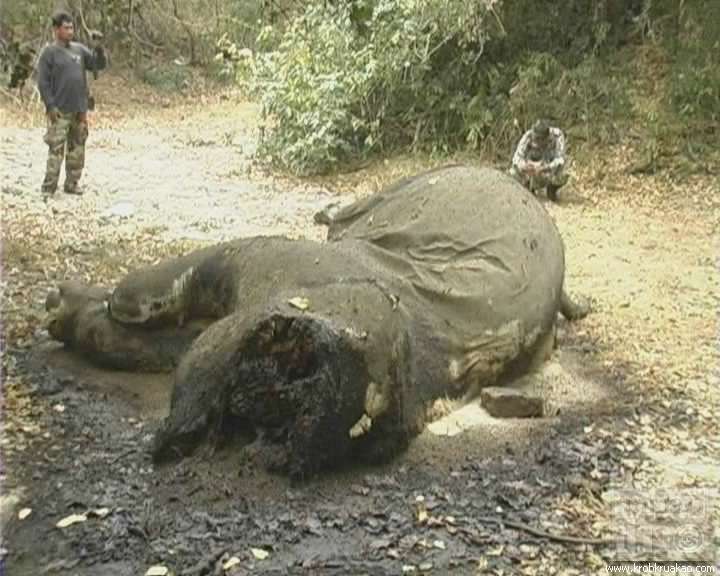
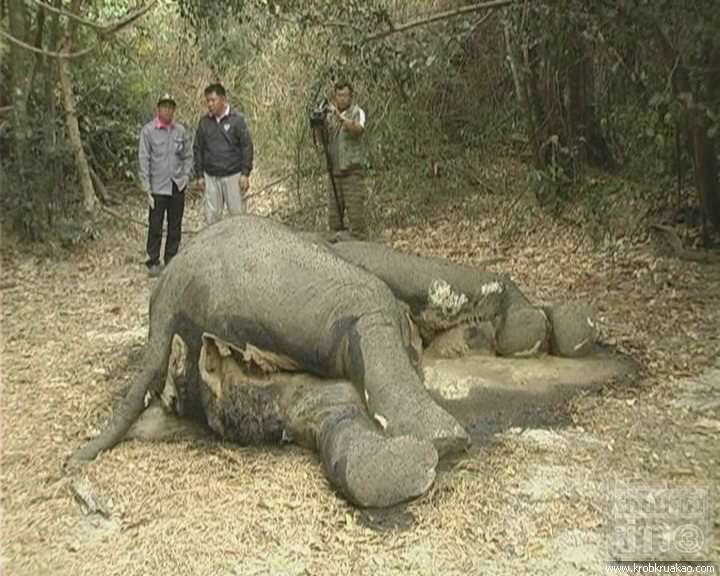
elephant killed at KKC
News on elephants in Thailand since the start of this year has been dominated by the brutal killing of wild tuskers in Kaeng Krachan and Kui Buri national parks. At least six wild elephants have been found dead within three weeks – and this is probably just the tip of the iceberg. Both national parks occupy a very large area, with Kaeng Krachan being Thailand’s biggest national park. Combined, the two national parks are home to at least 500 wild elephants.

In one of the first interviews after the discovery of five dead elephants one government official alleged that these animals were killed to provide elephant meat and sexual organs for consumption at wildlife “bush-meat” restaurants on Phuket Island, for visiting foreign tourists. This news was extremely shocking to a big part of the Thai society but to date it has not been proven right. In fact, neither the Natural Resources and Environmental Crime Suppression Division (NRECD), at the Royal Thai Police, or the office of the Phuket governor have found any evidence that such a place exists. Nor can the official that made the statement give any weight to his claim.
It seems like a deliberately made-up claim, for whatever reason, but the real reason for the killing of these elephants could be explained in a much easier way.

The demand for young elephants at elephant camps nationwide is rising because not enough elephants are being born in captivity to meet the demand. Although we see stories in the news every now and then about the birth of babies at elephant camps there are just not enough captive-born calves. This gap in demand and supply is reflected in the prices camp owners and businessmen are willing to pay. A two to four-year-old female, for example, can now fetch a staggering Bt800,000 or up to Bt900,000 each. 

Baby elephants are being taken out of the jungle in Thailand at any cost. Mothers are being shot and even their nannies and sub-adult males still with the herd trying to protect the calves. Poachers, who have been interviewed, say it is common to kill up to three elephants to take one baby from the forest. Once a few elephants are killed the baby elephant stays close to the killed adults while the rest of the herd usually runs for safety. Poachers then have limited time to get the baby out, fearing the return of the herd and/or any witnesses attracted by the sound of gunshots. This explains why some dead elephants were found with their tusks intact. Removing and selling the tusks would be very lucrative – a small pair would easily fetch Bt100,000 – but it just takes too much time. Groups of poachers like these will receive about Bt300,000 from middlemen for baby elephants at specific places such as Suan Phueng in Ratchaburi and Sai Yok in Kanchanaburi. But this even occurs in the North, in areas such as Tak and Mae Hong Son provinces.

Once the babies have been taken away from their forests they are moved to “safe houses” in border areas controlled by corrupt politicians, government officials and influential businessmen. Here, the young are “tamed” through week-long torture rituals to break their spirit. In many cases, they are then introduced to a “foster-mother”, a captive female elephant. This introduction is particularly important for the future transportation of the elephant out of areas controlled by the criminals. When transported, baby elephants are often said to be the offspring of the captive (legally owned) older female. The law in Thailand stipulates that any captive-born offspring needs to be registered – within nine years! – so, this is a major loophole open to abuse. Lately, however, gangs have been moving baby elephants in the back of closed, modified pick-up trucks. This is even more daring, and shows they have little fear of being caught, which is a clear sign they are backed up by influential people. The profit for these gangs is huge, with elephant camps paying up to Bt900,000 for a baby but the gang only paying the poachers about Bt300,000. Aside from some “costs”, such as bribing officials on the way, they can make up to Bt500,000 per elephant. It has been estimated that baby elephants are transported through Ratchaburi and Kanchanaburi at least twice a week. This suggests an annual turnover of at least 100 elephants or Bt80-90 million with a profit of Bt50 million for the smuggling gang. In the recent past, the Thai government always denied that smuggled elephants were from Thailand, claiming they come from Burma. However, the latest findings in Kaeng Krachan and Kui Buri indicate that this is a problem also exists in Thailand and that it urgently needs to be taken seriously.

There is no need for denial, action has to be taken and it has to be transparent.
For any tourist visiting elephant camps and riding these beautiful animals, the latest information has serious implications. People who ignore what is occurring effectively support the killing and torture of wild-born elephants.
For any government official or politician denying the above, I challenge you to go visit the elephant camps in Ayutthaya, Pattaya, Hua Hin, Samui, Chiang Mai, Phuket, or anywhere else in the country and force the owners of all elephants of up to 20 years of age to allow a DNA check on their animals. That would verify whether young elephants really are the offspring of their alleged mothers.

I strongly believe that over half of all young elephants in tourist camps nationwide are wild-caught. You can prove me wrong by undertaking a long-overdue DNA check. Indeed, I challenge you to verify the status of these glorious animals. This is the only way to reveal the true status of all young elephants and to wipe out this evil trade and the slaughter of a national icon.

Edwin Wiek is secretary-general of the Wildlife Friends Foundation Thailand (WFFT). He can be contacted at edwin.wiek@wfft.org.