Mostrando entradas con la etiqueta Plasma. Mostrar todas las entradas

lunes, 28 de marzo de 2016

New dawn: Chinese scientists move step closer to creating ‘artificial sun’ in quest for limitless energy via nuclear fusion

Chinese scientists were able to heat plasma to three times the temperature of the core of our sun for a record-breaking 102 seconds as they progressed the search to derive energy from nuclear fusion. Photo: Wikipedia
In a doughnut-shaped chamber in eastern China, scientists have been able to produce hydrogen gas more than three times hotter than the core of the Sun using nuclear fusion - and maintain this temperature for 102 seconds.

The breakthrough puts China one step ahead in the global race to harness a new, artificial kind of solar energy for clean and unlimited energy, the researchers claim. This has become a pressing concern as more of the earth’s natural reserves are rapidly depleting.

The experiment was conducted last week on a magnetic fusion reactor at the Institute of Physical Science in Hefei, capital of Jiangsu province, according to a statement on the institute’s website on Wednesday.

The reactor, officially known as the Experimental Advanced Superconducting Tokamak (EAST), was able to heat a hydrogen gas - a hot ionised gas called a plasma - to about 50 million Kelvins (49.999 million degrees Celsius). The interior of our sun is calculated to be around 15 million Kelvins.

Chinese scientists came a step closer to creating an artificial sun by heating hydrogen gas to 50 million Kelvins for a record time. Photo: Hefei Institute of Physical Science, Chinese Academy of Sciences
According to this thermodynamic scale, absolute zero occurs at zero degrees (equivalent to minus 273.15 degrees Celsius), a point at which all molecular movement stops.

The temperature reached in Hefei was at the other end of the scale, and roughly the same as a mid-sized thermonuclear explosion. The goal of the experiment was to approximate the nuclear fusion conditions that occur deep inside the sun.

Although at least one other experiment in the last decade claims to have produced a hotter temperatures than this, it has never been duplicated and was unable to match the endurance - over one and a half minutes - of the Chinese test.

Meanwhile, physicists in Japan and Europe have been able to reach the same temperature as the Chinese team, but not for longer than a minute due to concerns of provoking a reactor meltdown.

The EAST was invented by Soviet scientists to control nuclear fusion for power generation.

The EAST tokomak device in Hefei. In order to ‘fuse’ two hydrogen atoms to produce energy, it needs to heat the hydrogen plasma for 100 million Kelvins. Photo: Chinese Academy of Sciences
As a tokamak device, it uses a powerful magnetic field to confine plasma in the shape of a torus - imagine a large spinning doughnut -for safety reasons due to the phenomenally high temperatures being generated. The atoms are effectively held floating in place by superconducting magnets.

But controlling hydrogen gas in such a hot and volatile state is a formidable challenge, and one that most of the tokomak devices built over the last 60 years have not been able to sustain for more than 20 seconds.

The scientists in Hefei worked “day and night” to achieve the record level of endurance, according to the institute, which serves as a subsidiary of the Chinese Academy of Sciences.

The team claimed to have solved a number of scientific and engineering problems, such as precisely controlling the alignment of the magnet, and managing to capture the high-energy particles and heat escaping from the “doughnut”.

Inside the ‘doughnut’ (EAST). The metallic walls cannot come into direct contact with the plasma or it will melt or evaporate immediately. The scientists used a powerful magnetic field to keep the hot hydrogen gas suspended in place. Photo: Chinese Academy of Sciences
But they still missed their mark, which was to reach 100 million Kelvins for over 1,000 seconds (nearly 17 minutes), they said, adding that it would still take years to build a commercially viable plant that could operate in a stable manner for several decades.

Unlike the process of nuclear fission that fuels thermal power stations around the world today by splitting the atoms of fissile materials such as uranium, fusion reactions work by “fusing” two light atomic nuclei - for example, two hydrogen atoms - together to release a huge amount of heat.

This can produce levels of energy three to four times greater than the results of nuclear fission. It also generate almost no radioactive waste.

The problem is the amount of heat created. Whereas nuclear fission only generates a few hundred degrees Celsius, fusion requires at least 100 million degrees Celsius (212 million degrees Fahrenheit).

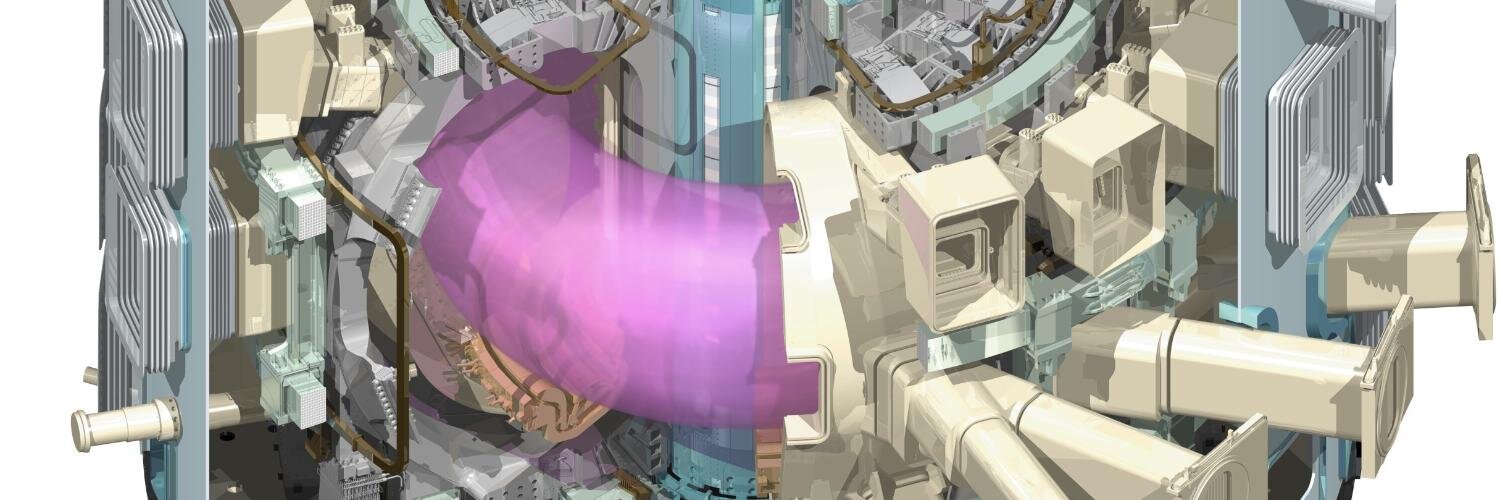
A researcher involved with the EAST project said data from their experiment may be of use to the International Thermonuclear Experimental Reactor (ITER) that is now under construction in France.
Source: @ITERORG

Meanwhile, another 1-billion-euro (US$1.12 billion) project in Germany dubbed the “stellarator” claimed last December to have achieved another milestone in the nuclear fusion quest by heating plasma to around 1 million degrees Celsius for one-tenth of a second.

A colourised computer image shows the moment the first superhot plasma was created in a separate experiment at the Wendelstein 7-X nuclear fusion research centre at the Max-Planck-Institut for Plasma Physics (IPP) in Greifswald, Germany in December. Photo: EPA


China ranks as a member country of the ITER project, which aims to produce 500 megawatts of fusion power for 400 seconds. But Beijing has expressed frustration with the slow pace of development, according to the same researcher, who asked not be identified.

The multibillion US dollar project was initially scheduled to become operational this year. But due to a series of setbacks, many now suspect it will need at least another decade.

“Political infighting among different nations about the project’s budget, personnel appointments and other issues are hampering the pace of the project,” said the researcher.

“If this chaotic situation continues, other projects in countries like the United States and China may overtake this collective, international effort.”

Stephen Chen. chen.binglin@scmp.com
05 February, 2016, 1:45pm


jueves, 22 de octubre de 2015

Feature: The bizarre reactor that might save nuclear fusion


If you’ve heard of fusion energy, you’ve probably heard of tokamaks. These doughnut-shaped devices are meant to cage ionized gases called plasmas in magnetic fields while heating them to the outlandish temperatures needed for hydrogen nuclei to fuse. Tokamaks are the workhorses of fusion—solid, symmetrical, and relatively straightforward to engineer—but progress with them has been plodding.

Now, tokamaks’ rebellious cousin is stepping out of the shadows. In a gleaming research lab in Germany’s northeastern corner, researchers are preparing to switch on a fusion device called a stellarator, the largest ever built. The €1 billion machine, known as Wendelstein 7-X (W7-X), appears now as a 16-meter-wide ring of gleaming metal bristling with devices of all shapes and sizes, innumerable cables trailing off to unknown destinations, and technicians tinkering with it here and there. It looks a bit like Han Solo’s Millennium Falcon, towed in for repairs after a run-in with the Imperial fleet. Inside are 50 6-tonne magnet coils, strangely twisted as if trampled by an angry giant.

Although stellarators are similar in principle to tokamaks, they have long been dark horses in fusion energy research because tokamaks are better at keeping gas trapped and holding on to the heat needed to keep reactions ticking along. But the Dali-esque devices have many attributes that could make them much better prospects for a commercial fusion power plant: Once started, stellarators naturally purr along in a steady state, and they don’t spawn the potentially metal-bending magnetic disruptions that plague tokamaks. Unfortunately, they are devilishly hard to build, making them perhaps even more prone to cost overruns and delays than other fusion projects. “No one imagined what it means” to build one, says Thomas Klinger, leader of the German effort.


W7-X could mark a turning point. The machine, housed at a branch of the Max Planck Institute for Plasma Physics (IPP) that Klinger directs, is awaiting regulatory approval for a startup in November. It is the first large-scale example of a new breed of supercomputer-designed stellarators that have had most of their containment problems computed out. If W7-X matches or beats the performance of a similarly sized tokamak, fusion researchers may have to reassess the future course of their field. “Tokamak people are waiting to see what happens. There’s an excitement around the world about W7-X,” says engineer David Anderson of the University of Wisconsin (UW), Madison.

Adapted from IPP by C. Bickel and A. Cuadra/Science
Wendelstein 7-X, the first large-scale optimized stellarator, took 1.1 million working hours to assemble, using one of the most complex engineering models ever devised, and must withstand huge temperature ranges and enormous forces.

Stellarators face the same challenge as all fusion devices: They must heat and hold on to a gas at more than 100 million degrees Celsius—seven times the temperature of the sun’s core. Such heat strips electrons from atoms, leaving a plasma of electrons and ions, and it makes the ions travel fast enough to overcome their mutual repulsion and fuse. But it also makes the gas impossible to contain in a normal vessel.

Instead, it is held in a magnetic cage. A current-carrying wire wound around a tube creates a straight magnetic field down the center of the tube that draws the plasma away from the walls. To keep particles from escaping at the ends, many early fusion researchers bent the tube into a doughnut-shaped ring, or torus, creating an endless track.

But the torus shape creates another problem: Because the windings of the wire are closer together inside the hole of the doughnut, the magnetic field is stronger there and weaker toward the doughnut’s outer rim. The imbalance causes particles to drift off course and hit the wall. The solution is to add a twist that forces particles through regions of high and low magnetic fields, so the effects of the two cancel each other out.

Stellarators impose the twist from outside. The first stellarator, invented by astro-physicist Lyman Spitzer at Princeton University in 1951, did it by bending the tube into a figure-eight shape. But the lab he set up—the Princeton Plasma Physics Laboratory (PPPL) in New Jersey—switched to a simpler method for later stellarators: winding more coils of wire around a conventional torus tube like stripes on a candy cane to create a twisting magnetic field inside.

In a tokamak, a design invented in the Soviet Union in the 1950s, the twist comes from within. Tokamaks use a setup like an electrical transformer to induce the electrons and ions to flow around the tube as an electric current. This current produces a vertical looping magnetic field that, when added to the field already running the length of the tube, creates the required spiraling field lines.

Both methods work, but the tokamak is better at holding on to a plasma. In part that’s because a tokamak’s symmetry gives particles smoother paths to follow. In stellarators, Anderson says, “particles see lots of ripples and wiggles” that cause many of them to be lost. As a result, most fusion research since the 1970s has focused on tokamaks—culminating in the huge ITER reactor project in France, a €16 billion international effort to build a tokamak that produces more energy than it consumes, paving the way for commercial power reactors.

But tokamaks have serious drawbacks. A transformer can drive a current in the plasma only in short pulses that would not suit a commercial fusion reactor. Current in the plasma can also falter unexpectedly, resulting in “disruptions”: sudden losses of plasma confinement that can unleash magnetic forces powerful enough to damage the reactor. Such problems plague even up-and-coming designs such as the spherical tokamak (Science, 22 May, p. 854).

Stellarators, however, are immune. Their fields come entirely from external coils, which don’t need to be pulsed, and there is no plasma current to suffer disruptions. Those two factors have kept some teams pursuing the concept.

The largest working stellarator is the Large Helical Device (LHD) in Toki, Japan, which began operating in 1998. Lyman Spitzer would recognize the design, a variation on the classic stellarator with two helical coils to twist the plasma and other coils to add further control. The LHD holds all major records for stellarator performance, shows good steady-state operation, and is approaching the performance of a similarly sized tokamak.

Two researchers—IPP’s Jürgen Nührenberg and Allen Boozer of PPPL (now at Columbia University)—calculated that they could do better with a different design that would confine plasma with a magnetic field of constant strength but changing direction. Such a “quasi-symmetric” field wouldn’t be a perfect particle trap, says IPP theorist Per Helander, “but you can get arbitrarily close and get losses to a satisfactory level.” In principle, it could make a stellarator perform as well as a tokamak.

The design strategy, known as optimization, involves defining the shape of magnetic field that best confines the plasma, then designing a set of magnets to produce the field. That takes considerable computing power, and supercomputers weren’t up to the job until the 1980s.

The first attempt at a partially optimized stellarator, dubbed Wendelstein 7-AS, was built at the IPP branch in Garching near Munich and operated between 1988 and 2002. It broke all stellarator records for machines of its size. Researchers at UW Madison set out to build the first fully optimized device in 1993. The result, a small machine called the Helically Symmetric Experiment (HSX), began operating in 1999. “W7-AS and HSX showed the idea works,” says David Gates, head of stellarator physics at PPPL.

That success gave U.S. researchers confidence to try something bigger. PPPL began building the National Compact Stellarator Experiment (NCSX) in 2004 using an optimization strategy different from IPP’s. But the difficulty of assembling the intricately shaped parts with millimeter accuracy led to cost hikes and schedule slips. In 2008, with 80% of the major components either built or purchased, the Department of Energy pulled the plug on the project (Science, 30 May 2008, p. 1142). “We flat out underestimated the cost and the schedule,” says PPPL’s George “Hutch” Neilson, manager of NCSX.

IPP/Wolfgang Filser. Wendelstein 7-X’s bizarrely shaped components must be put together with millimeter precision. All welding was computer controlled and monitored with laser scanners.
BACK IN GERMANY, the project to build W7-X was well underway. The government of the recently reunified country had given the green light in 1993 and 1994 and decided to establish a new branch institute at Greifswald, in former East Germany, to build the machine. Fifty staff members from IPP moved from Garching to Greifswald, 800 kilometers away, and others made frequent trips between the sites, says Klinger, director of the Greifswald branch. New hires brought staff numbers up to today’s 400. W7-X was scheduled to start up in 2006 at a cost of €550 million.


But just like the ill-fated American NCSX, W7-X soon ran into problems. The machine has 425 tonnes of superconducting magnets and support structure that must be chilled close to absolute zero. Cooling the magnets with liquid helium is “hell on Earth,” Klinger says. “All cold components must work, leaks are not possible, and access is poor” because of the twisted magnets. Among the weirdly shaped magnets, engineers must squeeze more than 250 ports to supply and remove fuel, heat the plasma, and give access for diagnostic instruments. Everything needs extremely complex 3D modeling. “It can only be done on computer,” Klinger says. “You can’t adapt anything on site.”

By 2003, W7-X was in trouble. About a third of the magnets produced by industry failed in tests and had to be sent back. The forces acting on the reactor structure turned out to be greater than the team had calculated. “It would have broken apart,” Klinger says. So construction of some major components had to be halted for redesigning. One magnet supplier went bankrupt. The years 2003 to 2007 were a “crisis time,” Klinger says, and the project was “close to cancellation.” But civil servants in the research ministry fought hard for the project; finally, the minister allowed it to go ahead with a cost ceiling of €1.06 billion and first plasma scheduled for 2015.

After 1.1 million construction hours, the Greifswald institute finished the machine in May 2014 and spent the past year carrying out commissioning checks, which W7-X passed without a hitch. Tests with electron beams show that the magnetic field in the still-empty reactor is the right shape. “Everything looks, to an extremely high accuracy, exactly as it should,” IPP’s Thomas Sunn Pedersen says.

Approval to go ahead is expected from Germany’s nuclear regulators by the end of this month. The real test will come once W7-X is full of plasma and researchers finally see how it holds on to heat. The key measure is energy confinement time, the rate at which the plasma loses energy to the environment. “The world’s waiting to see if we get the confinement time and then hold it for a long pulse,” PPPL’s Gates says.

Success could mean a course change for fusion. The next step after ITER is a yet-to-be-designed prototype power plant called DEMO. Most experts have assumed it would be some sort of tokamak, but now some are starting to speculate about a stellarator. “People are already talking about it,” Gates says. “It depends how good the results are. If the results are positive, there’ll be a lot of excitement.”

Posted in Physics

ORIGINAL: Science
21 October 2015
ADAPTED FROM IPP BY C. BICKEL/ SCIENCE

domingo, 14 de junio de 2015

Australian student confirms that giant plasma tubes are floating above Earth

Image: CAASTRO/Mats Bjorklund

Astronomers have for the first time captured visual evidence of the existence of tubular plasma structures in the inner layers of the magnetosphere surrounding the Earth.
“For over 60 years, scientists believed these structures existed but by imaging them for the first time, we’ve provided visual evidence that they are really there,” Cleo Loi of the ARC Centre of Excellence for All-sky Astrophysics (CAASTRO) and the School of Physics at the University of Sydney said.

Loi is the lead author on this research, done as part of her award-winning undergraduate thesis and published in the journal Geophysical Research Letters.

“The discovery of the structures is important because they cause unwanted signal distortions that could, as one example, affect our civilian and military satellite-based navigation systems. So we need to understand them,” she said.

The plasma structures are explained in this clip:


The region of space around the Earth occupied by its magnetic field, called the magnetosphere, is filled with plasma created by the atmosphere being ionised by sunlight.

The innermost layer of the magnetosphere is the ionosphere, and above that is the plasmasphere. They are embedded with a variety of strangely shaped plasma structures, including the tubes.

“We measured their position to be about 600 km above the ground, in the upper ionosphere, and they appear to be continuing upwards into the plasmasphere. This is around where the neutral atmosphere ends, and we are transitioning to the plasma of outer space,” Loi said.

Cleo Loi via Sydney Morning Herald

Using the Murchison Widefield Array, a radio telescope in the Western Australian desert, Loi found that she could map large patches of the sky and exploit the the array’s rapid snapshot capabilities to create a movie - effectively capturing the real-time movements of the plasma.

Loi has been awarded the 2015 Bok Prize of the Astronomical Society of Australia for her work


ORIGINAL: Science Alert
CHRIS PASH, BUSINESS INSIDER
2 JUN 2015

sábado, 11 de mayo de 2013

New Plasma Device Considered The Holy Grail Of Energy Generation And Storage

ORIGINAL: CNN
April 17, 2013


University of Missouri engineer Randy Curry and his team have developed a method of creating and controlling plasma that could revolutionize American energy generation and storage. The basic research program was originally funded by the Office of Naval Research, but continued research has been funded by MU.

credit: MU


Image Credit: Roman Pyshchyk / Shutterstock
Scientists at the University of Missouri have devised a new way to create and control plasma that could transform American energy generation and storage.

Randy Curry, professor of electrical and computer engineering at the University of Missouri’s College of Engineering, and his team developed a device that launches a ring of plasma at distances of up to two feet. Although the plasma reaches a temperature hotter than the surface of the sun, it doesn’t emit radiation and is completely safe in proximity to humans.

While most of us are familiar with three states of matter – liquid, gas and solid – there is also a fourth state known as plasma, which includes things such as fire and lightning. Life on Earth depends on the energy emitted by plasma produced during fusion reactions within the sun.

The secret to Curry’s success was developing a way to make plasma form its own self-magnetic field, which holds it together as it travels through the air.

“Launching plasma in open air is the ‘Holy Grail’ in the field of physics,” said Curry.

“Creating plasma in a vacuum tube surrounded by powerful electromagnets is no big deal; dozens of labs can do that. Our innovation allows the plasma to hold itself together while it travels through regular air without any need for containment.”

The plasma device could also be enlarged to handle much larger amounts of energy, he said.

For the current work, Curry and his team used older technologies to build their prototype of a plasma-generating machine. But a considerably smaller device using newer, miniaturized parts could also be built within three to five years with sufficient funding, Curry said.

“We have a world-class team at MU’s Center for Physical & Power Electronics, but that team will evaporate without funding.”

Source: redOrbit Staff & Wire Reports - Your Universe Online


martes, 23 de abril de 2013

Plasma Ring Experiment Offers New Path for Fusion Power

ORIGINAL: IEEE Spectrum
By Jeremy Hsu
April 19, 2013

Image credit: University of Missouri
Physicists usually rely on electromagnetic fields to harness the power of plasma, the fourth state of matter, in fusion power experiments. But University of Missouri researchers have managed to create rings of plasma that can hold their shape without the use of outside electromagnetic fields—possibly paving the way for a new age of practical fusion power and leading to the creation of new energy storage devices. 

Traditional efforts to achieve nuclear fusion have relied upon multi-billion-dollar fusion reactors, called tokamaks, which harness powerful electromagnetic fields to contain the super-heated plasmas resulting from the fusion reactions. The ability to create plasma with self-confining electromagnetic fields in the open air could eliminate the need for external electromagnetic fields in future fusion experiments, and with it, much of the expense. 

The researchers created plasma rings about 15 centimeters in diameter that flew through the air across distances up to 60 centimeters. The rings lasted just 10 milliseconds, but reached temperatures greater than the sun's fiery fusion core at around 6600 to 7700 degrees K (6327 to 7427 degrees C). Plasma physicists suspect that magnetic fields are still involved—but that the plasma rings create their own. 

"This plasma has a self-confining magnetic field," said Randy Curry, an engineer and physicist at the University of Missouri in Columbia. "If one can generate and contain it without large magnets involved, of course fusion energy would be an application." But the researchers' success in creating self-contained plasma rings came as a surprise. "We did not expect that," Curry says. 

The researchers had been working with exploding wires that vaporize when pulsed power is applied and release a cloud of plasma energy. They had previously only succeeded in making clouds of plasma that lasted less than a millisecond, Curry said. 

The breakthrough came from adding more pulsed power to the plasma. Curry and a graduate student injected the added energy into a "second acceleration region" of their lab device, and set up the conditions that allowed the plasma ring to be launched from the device. 

Such basic physics research could also lead to better energy storage for both civilian and military applications. Curry's lab plans to examine the possibility of a "plasma capacitor" that stores tens of joules of energy per cubic centimeter, as opposed to traditional capacitors that hold less than one joule per cubic centimeter. 

The self-contained plasma rings created in air could also benefit the manufacturing of metals, plastics and semiconductors. Plasma is currently used to help with semiconductor etching and the modification of other surfaces, but requires vacuum containment vessels and expensive electromagnets to remain contained. 

The research was originally funded by the U.S. Department of Defense through the Office of Naval Research. Curry's lab aims to secure new funding to build a smaller version of the plasma device about the size of a bread box within the next three to five years. 

But Curry also pointed out that such military funding for basic research has collapsed since sequestration took effect and slashed funding across the board for the U.S. government. In that sense, the plasma ring experiment's success also serves as a warning of what the U.S. could miss out on. According to an article in Science magazine published today, the administration's proposed 2014 budget would restore many of those cuts to scientific research.